
Chemistry: Grade 11 10 Sections49 Lessons8 Quizzes365 Days
1.1: Introduction
How Atomic Theory Was Developed?
Chemistry 11
Lesson Competencies
At the end of the lesson you will be able to:
Compare the views of different philosophers on the nature of matter.
Correctly name at least one philosopher and their viewpoint on matter.
Explain the basic idea of “atomos”.
Key Terms
Matter
Anything that has mass and occupies space.
Atomos
A Greek word meaning “uncuttable” or “indivisible”.
Philosophy
The study of fundamental questions about existence, knowledge, and reason.
Atomic Theory
The scientific theory that matter is composed of discrete units called atoms.
Video Lesson
Core Lesson: The Ancient Quest for Matter
Dear learners,
Have you ever wondered what the world is made of? If you take a piece of injera and tear it in half, and then tear that half in half again, could you keep doing this forever? Or would you eventually reach a tiny piece that cannot be torn any further?
This simple question is one of the oldest in science. Thousands of years ago, long before laboratories and microscopes, ancient Greek philosophers debated this very idea. Their thinking laid the foundation for our modern understanding of the atom.
Two Competing Ideas
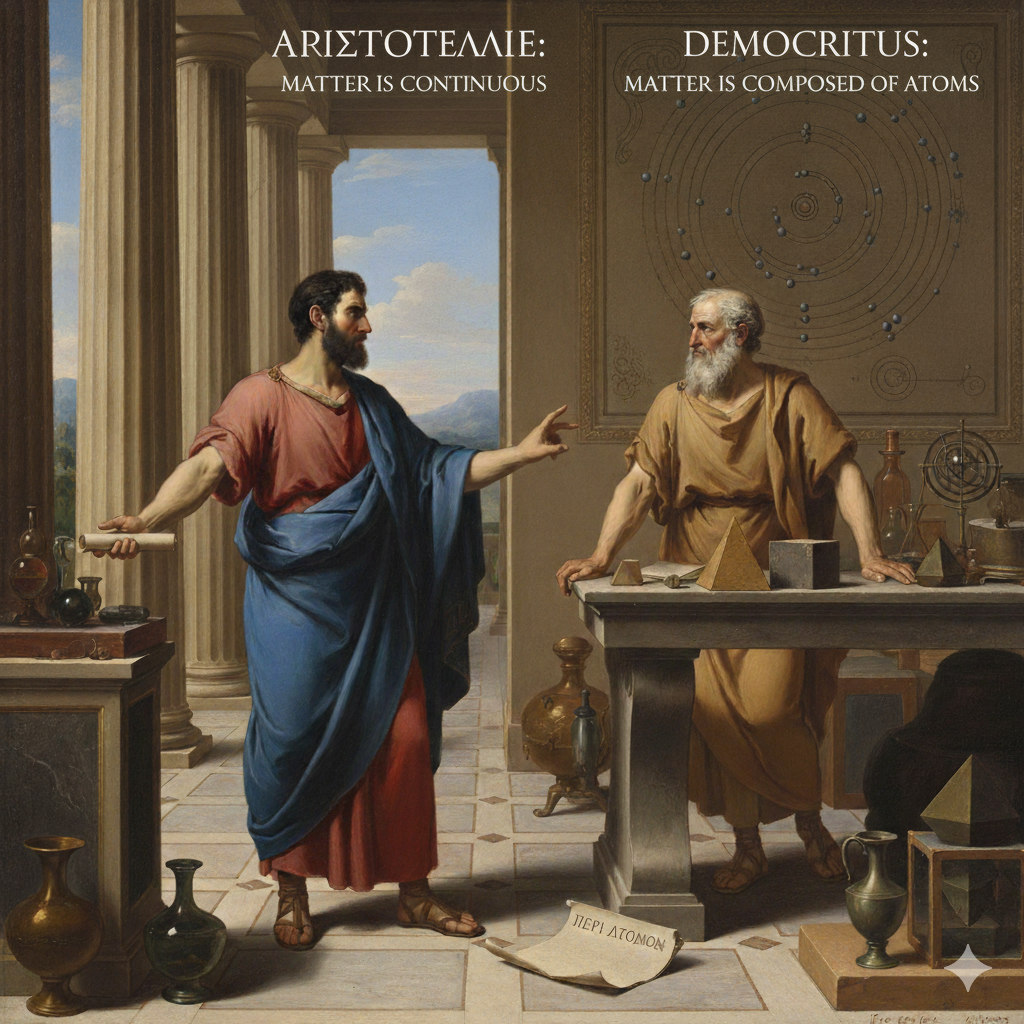
The ancient Greeks used logic and reason, not experiments, to understand the world.
Viewpoint 1: Matter is Continuous (Aristotle)
One of the most influential philosophers, Aristotle (c. 384–322 BC), believed that you could divide matter forever. He thought all matter was a combination of four fundamental elements: earth, air, fire, and water. According to him, there was no smallest particle. This was known as the “continuous” theory of matter.
Viewpoint 2: Matter is Particulate (Democritus)
Another philosopher, Democritus (c. 460–370 BC), proposed a radical new idea. He argued that if you keep dividing matter, you will eventually reach a tiny, fundamental particle that is indivisible. He called this particle “atomos,” which means “uncuttable” in Greek. This was the “particulate” or “atomistic” theory of matter.
Illustrating the Ideas
Aristotle’s Continuous View
Imagine a line. You can always find a point halfway between any two other points. Aristotle saw matter this way—infinitely divisible, with no basic units.
Democritus’s “Atomos” View
Imagine a wall made of bricks. You can’t divide a brick in half and still call it a brick. Democritus saw matter this way—made of fundamental, unbreakable building blocks (atoms).
Activity 1: Check Your Understanding
Answer the following questions to test your knowledge.
Activity 2: True or False?
Read each statement and decide if it is true or false.
Activity 3: Match the Concepts
Drag each philosopher or term to its correct description.
Items
Descriptions
Believed matter was continuous and made of earth, air, fire, and water.
Proposed that matter was made of tiny, indivisible particles.
Aristotle’s proposed fundamental substances.
The Greek term for an “uncuttable” particle.
Lesson Summary
Ancient Greek philosophers were among the first to develop theories about the nature of matter.
Aristotle championed the idea of continuous matter, believing it could be divided infinitely and was composed of four elements (earth, air, fire, water).
Democritus proposed the idea of particulate matter, suggesting that everything is made of tiny, indivisible, and indestructible particles called “atomos.”
These early philosophical ideas, though not based on experiment, started the long journey toward modern atomic theory.
Final Assessment
Let’s see what you’ve learned. Answer these final questions.
Competency Checklist
Review the goals from the start of the lesson. Check off the ones you feel confident about.