
Economics : Grade 12 12 Sections46 Lessons365 Days
1.1: Definition and Focus area of Macroeconomics
Economics Grade 12
Lesson Competencies
At the end of the lesson you will be able to:
Define macroeconomics and differentiate it from microeconomics.
Identify the major focus areas and goals of macroeconomics.
List and describe key macroeconomic variables.
Explain the three main approaches to measuring Gross Domestic Product (GDP) with examples.
Key Terms
Macroeconomics
The branch of economics that studies the behavior and performance of an economy as a whole.
Gross Domestic Product (GDP)
The total market value of all final goods and services produced within a country’s borders in a specific time period.
Inflation
The rate at which the general level of prices for goods and services is rising, and subsequently, purchasing power is falling.
Unemployment
The state of being jobless for individuals who are actively seeking employment but are unable to find work.
Video Lesson
Core Lesson: Understanding the Big Picture
Dear learners,
Have you ever listened to the news and heard reports about Ethiopia’s economic growth, the price of teff in the market, the government building new roads, or the number of jobs created by industrial parks like the one in Hawassa? These are all “big picture” topics. They don’t just affect one person or one company; they affect the entire nation. This is the world of macroeconomics!
While microeconomics looks at the decisions of individual people and businesses (like why your family chooses to buy injera from a specific bakery), macroeconomics zooms out to look at the economy as a whole. It helps us understand the forces that shape our national economy.
Focus Areas and Goals of Macroeconomics
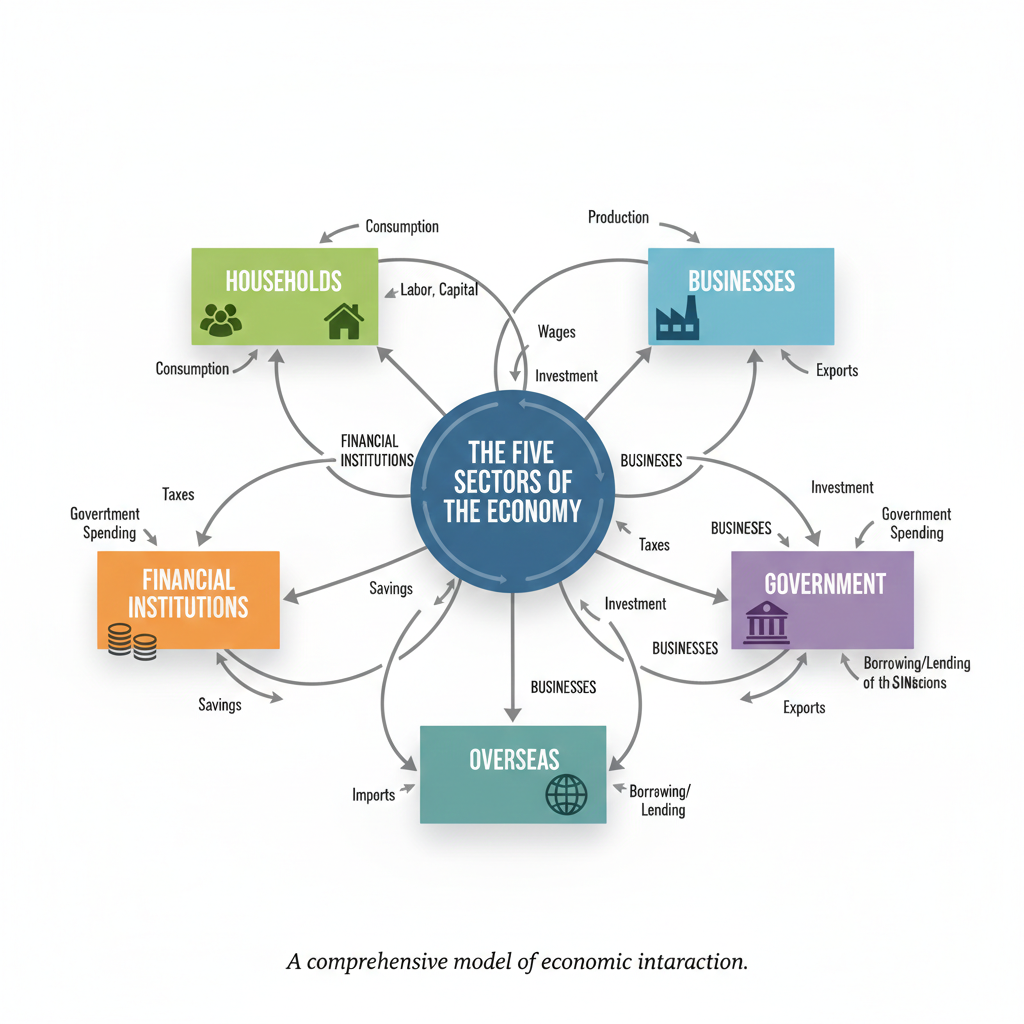
Macroeconomics analyzes the entire economy, from agriculture and industry to services.
1. Economic Growth
This is the increase in the amount of goods and services produced over a period of time. A major goal is to have steady, sustainable growth. For example, the expansion of Ethiopia’s agricultural exports, like coffee and flowers, contributes to national economic growth.
2. Full Employment
This means that all available labor resources are being used in the most efficient way possible. The goal is to keep unemployment low. Government initiatives to create jobs for the youth in urban areas are a macroeconomic policy aimed at achieving this.
3. Price Stability
This refers to controlling inflation. Rapidly rising prices can harm the economy and reduce the purchasing power of people’s savings. The National Bank of Ethiopia works to keep the inflation of the Birr at a manageable level.
4. External Balance
This relates to a country’s transactions with the rest of the world, mainly its balance of payments. A key goal is to maintain a stable exchange rate and manage the trade balance (exports vs. imports). For Ethiopia, managing the foreign currency earned from coffee exports against the currency spent on importing fuel is a major macroeconomic challenge.
Approaches to Measuring GDP
To understand how the economy is performing, we need to measure it. The most common measure is the Gross Domestic Product (GDP). There are three ways to calculate it, and all should give the same result.
A. The Product (Output) Approach
This approach sums up the market value of all final goods and services produced in the country. To avoid double-counting, we sum the “value added” at each stage of production.
Example: A farmer in Gojjam grows teff (value: 1000 Birr). A miller buys it and turns it into flour (value added: 500 Birr). A bakery uses the flour to make injera (value added: 800 Birr). The contribution to GDP is the final value of the injera (2300 Birr), or the sum of the value added at each stage (1000 + 500 + 800 = 2300 Birr).
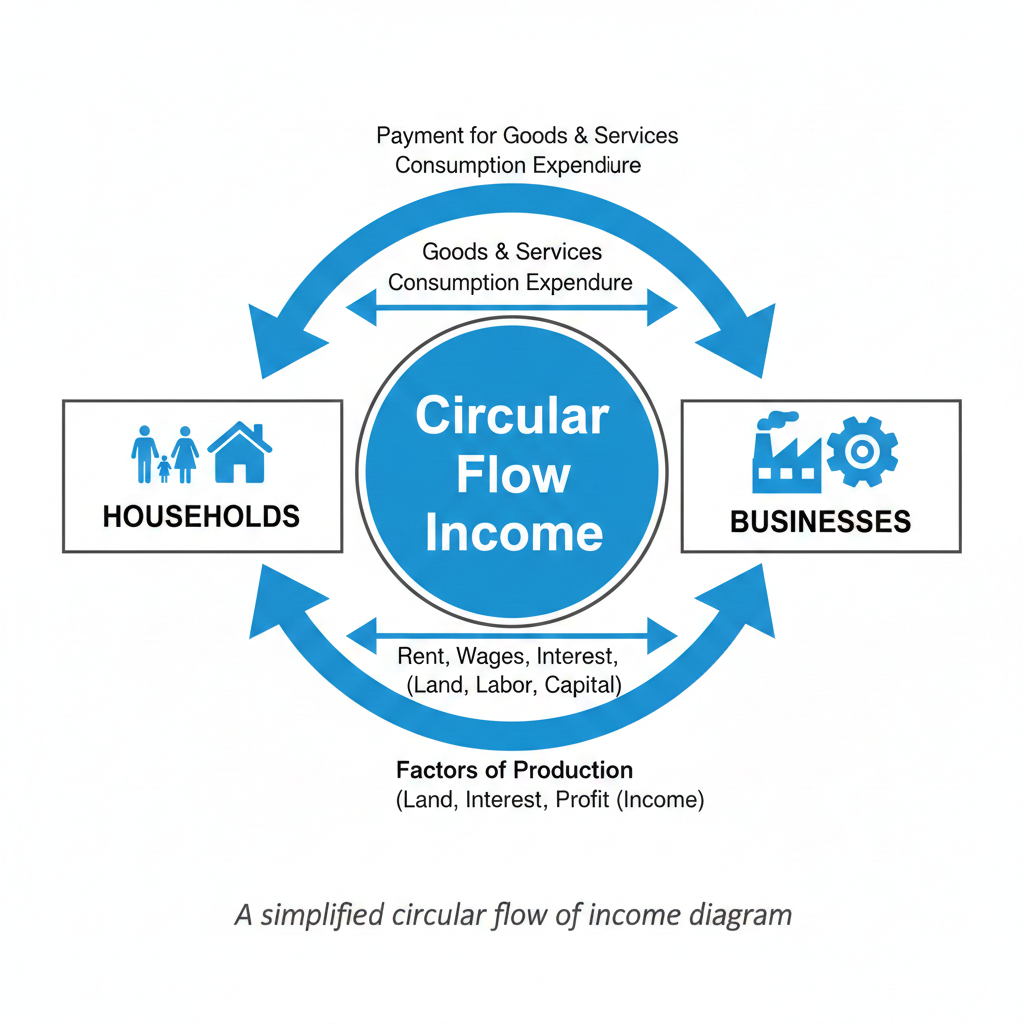
B. The Income Approach
This approach sums all the incomes generated by production. This includes wages paid to workers, rent for land, interest on capital, and profits for entrepreneurs.
Example: In a textile factory in Adama, the total income would be the sum of all employee salaries, the rent for the factory building, interest paid on loans for machinery, and the factory owner’s profits. Summing this up for all producers in Ethiopia gives the GDP.
C. The Expenditure Approach
This approach sums up the total spending on all final goods and services. The formula is GDP = C + I + G + (X – M).
C (Consumption): A family in Addis Ababa buying food and clothes.
I (Investment): A construction company buying new machinery.
G (Government Spending): The government paying to build a new university in Semera.
(X – M) (Net Exports): The value of coffee Ethiopia exports (X) minus the value of cars it imports (M).
Illustration: GDP Measurement
Activity 1: Check Your Understanding
Activity 2: True or False
Activity 3: Match the Concepts
Drag the examples to the correct macroeconomic goal they represent.
Ethiopian Scenarios
Macroeconomic Goals
Economic Growth
Full Employment
Price Stability
External Balance
✨ Policy Idea Generator
Now that you’ve learned about macroeconomic goals, let’s apply your knowledge! Enter a macroeconomic challenge for Ethiopia below, and our AI assistant will help you brainstorm some potential policy ideas a government might consider.
Generating ideas… please wait.
Lesson Summary
Macroeconomics studies the economy as a whole, focusing on large-scale issues like growth, employment, and inflation.
The main goals are stable economic growth, low unemployment (full employment), price stability, and a healthy external balance.
GDP is the key measure of a country’s economic output and can be calculated using the Product, Income, or Expenditure approaches.
Understanding these concepts helps us analyze national economic policies and current events in Ethiopia and the world.
Final Assessment
Competency Checklist
Check the boxes below to confirm you have met the lesson’s learning goals.