
English Grade 6 14 Sections44 Lessons365 Days
1.2 Reading and Vocabulary
Traditional Ethiopian Games
English Sixth Grade
Lesson Competencies
At the end of the lesson you will be able to:
Define key vocabulary related to traditional games, such as gebeta, rules, and strategy.
Identify the main idea and supporting details in a text about traditional Ethiopian games.
Infer the meaning of unfamiliar words using context clues from the reading passages.
Describe the rules and objective of a traditional game based on a written description.
Summarize the cultural importance of traditional games as described in a text.
Key Terms
Gebeta (ገበታ)
A traditional Ethiopian board game of strategy where players move seeds or stones around a board with pits.
Segno Maksegno (ሰኞ ማክሰኞ)
A popular children’s hopping game, similar to hopscotch, drawn on the ground.
Rules
A set of instructions that explain how a game is played and what is allowed or not allowed.
Strategy
A careful plan for winning a game or achieving a goal over a long period.
Teamwork
When a group of people work well together to achieve a common goal.
Objective
The main goal or purpose of the game; what you are trying to do to win.
Pre-Reading Activities
Dear learners,
Think about your favorite game to play. Is it on a phone, or is it outside with your friends? Long before phones and computers, children in Ethiopia had many exciting games to play. These traditional games are an important and fun part of our culture.
Brainstorming Scenario
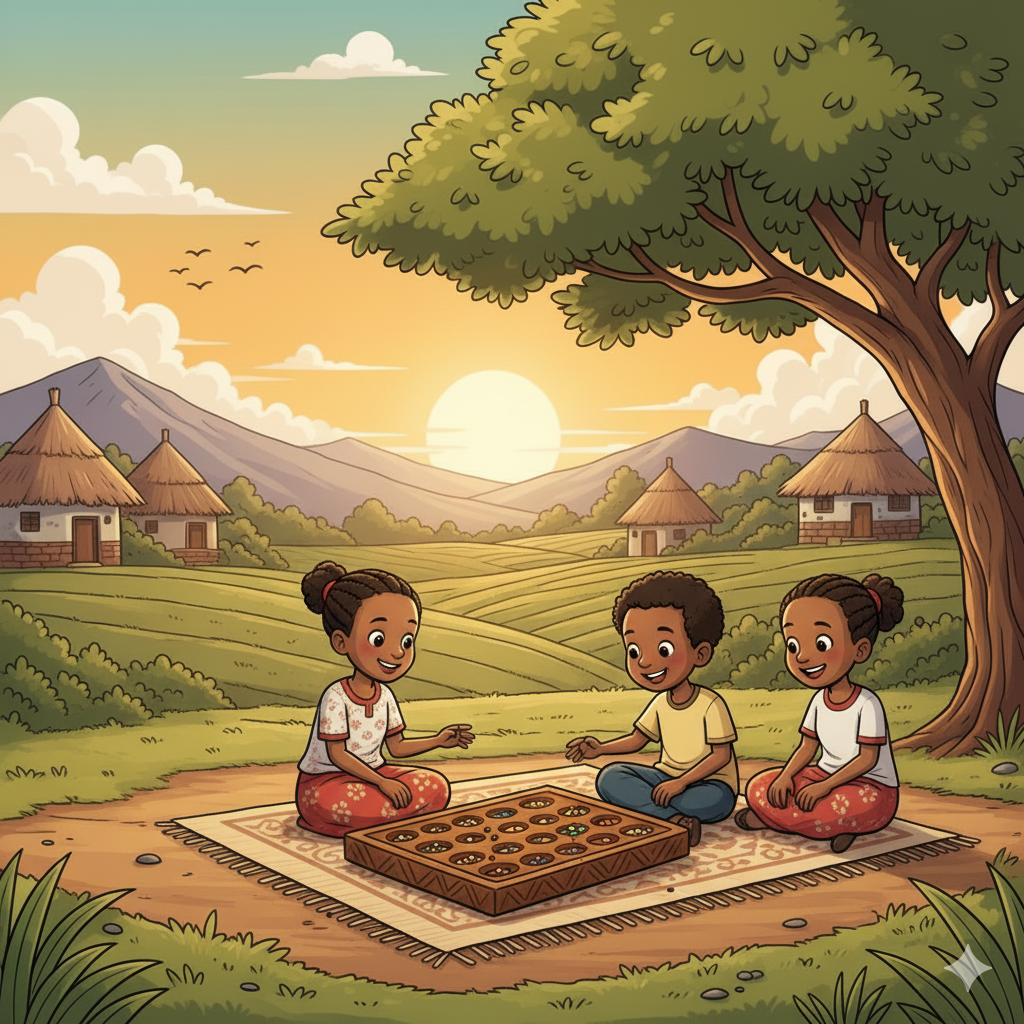
Imagine playing a fun game all by yourself. Now, imagine playing that same game with a group of your best friends. Which one is more fun? Traditional games bring people together.
Before You Read
As you read the following passage, think about these questions:
- What is the main difference between Gebeta and Segno Maksegno?
- What is one benefit of playing traditional games?
- What does the author suggest is important for keeping these games alive?
Reading Comprehension
Read the passage about traditional games and answer the questions that follow.
Passage: The Joy of Our Games
In Ethiopia, the laughter of children is often the sound of traditional games being played. These games are more than just fun; they are a connection to our parents and grandparents. Two of the most popular games are Gebeta and Segno Maksegno.
Gebeta is a quiet game of strategy. Players like Abebe sit calmly, thinking carefully before moving seeds across a wooden board. The objective is to capture more seeds than your opponent. It teaches patience and planning. On the other hand, Segno Maksegno is a loud and active game. Children like Chaltu will draw squares on the ground and hop through them, trying not to step on the lines. It is a game of skill and balance.
These games are communal activities. They bring friends together in the neighborhood after school. By playing them, we do more than just pass the time. We keep our culture alive for the future. Sharing these games with younger siblings and friends is essential to make sure they are not forgotten.
Vocabulary Practice
Use your knowledge of the key terms and the reading passage to answer the questions.
Lesson Summary
Traditional games like Gebeta and Segno Maksegno are an important part of Ethiopian culture.
Gebeta is a game of quiet strategy, while Segno Maksegno is an active game of skill.
Every game has an objective (a goal) and a set of rules to follow.
Some games require individual skill, while others, like Gena, require good teamwork.
Playing these games helps keep our traditions alive and brings communities together.
Final Assessment
Read the new passage and answer the questions to test your knowledge.
Passage: Playing Gena at Timket
During the celebration of Timket, you can often see people playing a special game called Gena. It is similar to field hockey and is a very old part of our heritage. In Gena, two teams try to hit a wooden ball with curved sticks towards the other team’s goal. It is a fast and exciting game that requires a lot of energy.
Success in Gena depends on great teamwork. Players must communicate and pass the ball to each other to move it down the field. A single talented player cannot win alone; the whole team must work together. When a team scores, the entire village cheers. This shared excitement strengthens the spirit of the community. Gena is more than a sport; it is a tradition that unites people during an important festival.
Competency Checklist
Check off each competency as you master it to complete the lesson: