
Social studies: Grade 7 11 Sections46 Lessons365 Days
1.4 Earth’s Internal and External Structures
Earth’s Internal and External Structures
Social Studies – Grade 7
Lesson Competencies
At the end of the lesson you will be able to:
Identify the sources of information about the Earth’s interior.
Describe the internal structure of the Earth (Crust, Mantle, Core).
Explain the external components of the Earth (Atmosphere, Hydrosphere, Lithosphere, Biosphere).
Differentiate between the internal and external structures of the Earth.
Key Terms
Atmosphere
The layer of gases surrounding the Earth.
Biosphere
The parts of the Earth where life exists.
Core
The extremely hot, dense center of the Earth.
Hydrosphere
All the water on Earth’s surface, such as oceans, lakes, and rivers.
Lithosphere
The rigid outer part of the earth, consisting of the crust and upper mantle.
Crust
The thin, solid, outermost layer of the Earth.
Mantle
The thick layer of semi-solid, hot rock between the Earth’s crust and core.
Video Lesson
Core Lesson: Our Amazing Planet Earth
Dear learners,
Have you ever wondered what our planet is made of? If we could travel to the very center of the Earth, what would we see? It’s a journey we can’t physically take, but scientists have found clever ways to explore what lies beneath our feet and what surrounds our world.
Today, we will explore the two main parts of our planet: its deep internal structure and its life-sustaining external components.
How Do We Know What’s Inside?
Since we cannot drill to the center of the Earth, scientists act like doctors for the planet. They use two main clues:
- Seismic Waves: These are waves of energy caused by earthquakes. By studying how these waves travel through the Earth, scientists can figure out if the layers are solid or liquid.
- Volcanic Eruptions: When a volcano erupts, it brings up materials like lava from deep inside the Earth. Studying this material gives us direct samples of the Earth’s interior.
A Journey to the Center of the Earth
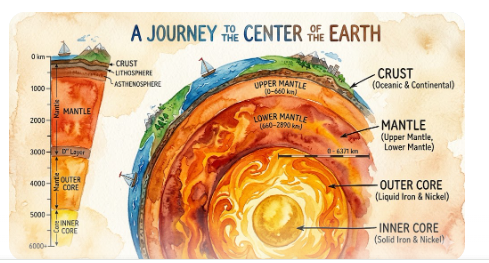
The Internal Structure
1. The Crust
This is the thin outer layer we live on, like the skin of an apple. It’s made of solid rock and is thinnest under the oceans and thickest under mountains.
2. The Mantle
This is the thickest layer of the Earth, found right below the crust. It’s mostly solid rock, but it’s so hot that it can flow slowly like thick honey. This movement causes earthquakes and volcanoes.
3. The Core
This is the center of the Earth and it has two parts. The Outer Core is made of liquid iron and nickel, and its movement creates Earth’s magnetic field. The Inner Core is a solid ball of iron and nickel, incredibly hot but solid because of the immense pressure.
The External Components (The Four Spheres)
1. Lithosphere
This is the solid, rocky part of the Earth, which includes the crust and the cool, rigid top part of the mantle. It’s the ground beneath our feet and the foundation of continents and ocean floors.
2. Hydrosphere
This sphere includes ALL the water on Earth—oceans, seas, lakes, rivers, ice caps, glaciers, and even the water in the air. About 71% of the Earth is covered by water!
3. Atmosphere
This is the blanket of gases that surrounds our planet. It protects us from the sun’s harmful radiation, gives us air to breathe, and creates our weather.
4. Biosphere
This sphere contains all living things on Earth, from the smallest bacteria to the largest whales. It includes life on land, in the water, and in the air. All four spheres must work together to support life.
Interactive Lab: Earth Scanner
Use the geological scanner to explore Earth’s layers. Play Mission Mode to test your knowledge!
Click a layer to scan
Activity 1: Check Your Knowledge
Activity 2: Match the Layers
Drag each layer of the Earth to its correct description.
Earth’s Layers
Descriptions
The thin, solid outer layer we live on.
The thickest layer, made of hot, flowing rock.
The super-hot, dense center of the planet.
All of the water on Earth.
All of the living things on Earth.
Activity 3: Complete the Sentences
Lesson Summary
Earth has a layered internal structure consisting of the crust, mantle, and core.
The crust is the thin, solid outer layer we live on.
The mantle is the thickest layer, made of hot, slowly flowing rock.
The core is the super-hot center, with a liquid outer part and a solid inner part.
Earth’s external components are four interconnected spheres: the rocky Lithosphere, the watery Hydrosphere, the gassy Atmosphere, and the living Biosphere.
Final Assessment
Competency Checklist
Check off the skills you have learned in this lesson.