
Physics: Grade 9 11 Sections52 Lessons2 Quizzes365 Days
1.1 Definition and Nature of Physics
Physics: Grade 9th
Lesson Competencies
At the end of the lesson you will be able to:
Define Physics and identify its main components.
Explain the relationship between Matter and Energy.
Describe the experimental nature of physics.
Identify the major branches of physics in everyday Ethiopian context.
Key Terms
Physics
The natural science that studies matter, its fundamental constituents, its motion and behavior through space and time, and the related entities of energy and force.
Matter
Anything that has mass and takes up space (volume). The coffee in a Jebena, the air we breathe, and the rocks on Entoto Mountain are all matter.
Energy
The quantitative property that must be transferred to an object in order to perform work on, or to heat, the object. It comes in many forms like heat, light, and motion.
Experiment
A scientific procedure undertaken to make a discovery, test a hypothesis, or demonstrate a known fact. Physics relies heavily on experimental proof.
Video Lesson
Watch this quick introduction to understand how physics is everywhere around us!
Core Lesson: What is Physics?
Introduction
Dear learners,
Imagine you are running in the famous Great Ethiopian Run in Addis Ababa. As you run, your body moves, you sweat, and you hear the cheering crowd. Have you ever wondered why you feel hot, how the sound travels to your ears, or how your muscles produce movement? The answer to all these questions is found in a subject called Physics.
Physics is the most fundamental of all sciences. It seeks to understand how the universe behaves. At its core, physics is the study of Matter and Energy and how they interact with each other.
The Two Pillars of Physics
Matter
The “stuff” the universe is made of. E.g., The wood burning in a fire.
Energy
What makes matter move or change. E.g., The heat and light from the fire.
The Nature of Physics
Physics is not just about memorizing facts; it is a process of discovery. It has two main characteristics:
1. It is an Experimental Science
Physicists observe nature, come up with ideas (hypotheses), and then perform experiments to test those ideas. If an experiment proves an idea wrong, the idea must be changed.
2. Mathematics is its Language
To explain laws clearly and exactly, physicists use math. For example, Einstein’s famous equation perfectly describes how mass and energy are connected!
Branches of Physics in Daily Life
Because the universe is so vast, physics is divided into several branches. Let’s look at them through an Ethiopian lens:
- Mechanics: Studies motion and forces. (e.g., A Minibus taxi traveling from Bole to Piazza).
- Thermodynamics (Heat): Studies temperature and heat transfer. (e.g., Baking Injera on a hot Mitad).
- Acoustics (Sound): Studies mechanical waves. (e.g., The beautiful sound produced by playing a Masenqo or Kirar).
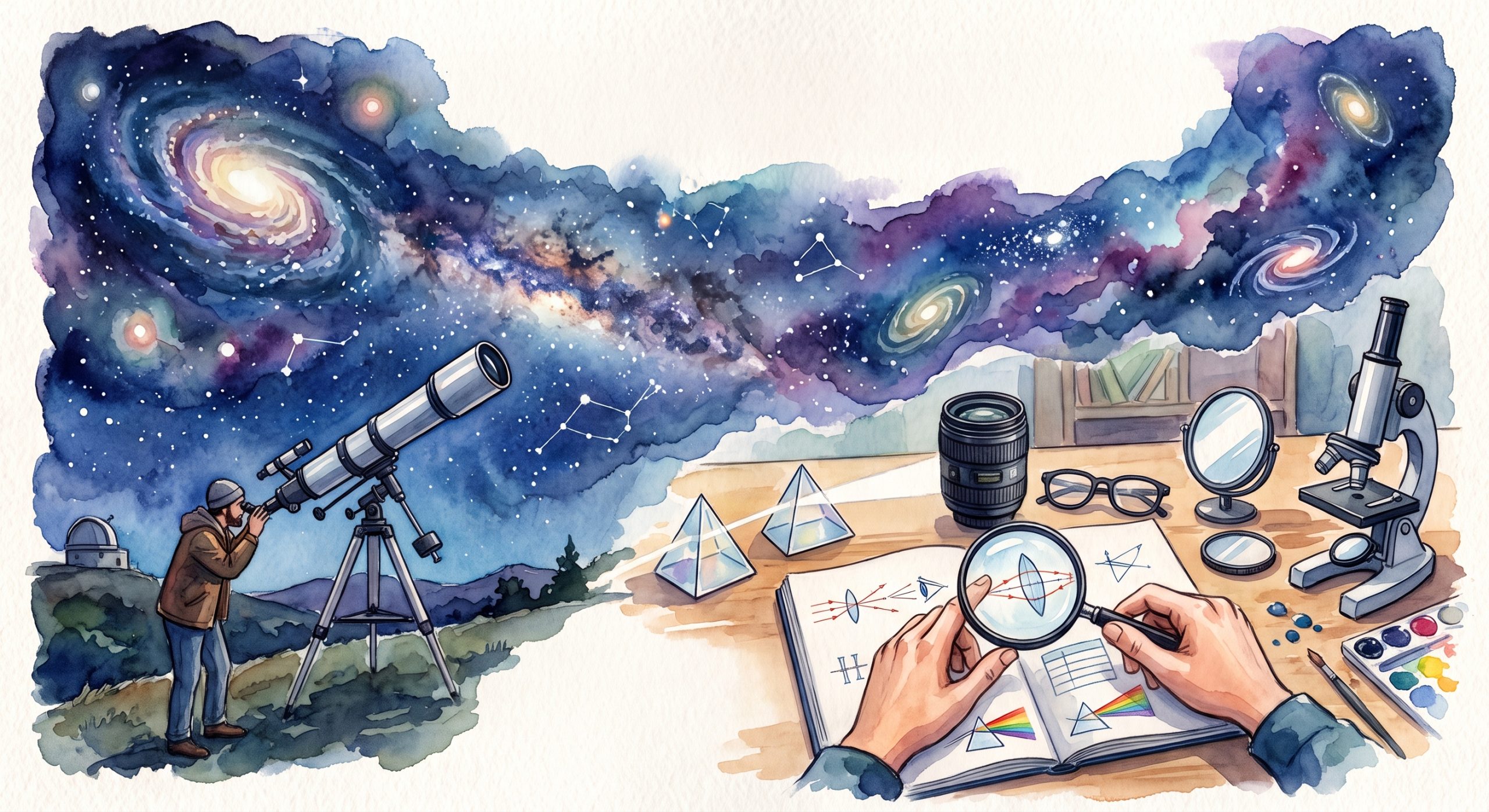
- Optics (Light): Studies the behavior of light. (e.g., How eyeglasses help you read).
- Electromagnetism: Studies electricity and magnetism. (e.g., How your mobile phone charges and receives calls).
Visualizing Physics Branches
Virtual Lab: Force and Motion
Experiment with forces! Mechanics is a core branch of physics. Try pushing the box and see how forces affect motion.
Game: Tile Flip Discovery
Click on the real-world Ethiopian examples to reveal which branch of Physics studies them!
Baking on a hot Mitad
Thermodynamics
Throwing a Javelin
Mechanics
Listening to a Kirar
Acoustics
Using Eyeglasses
Optics
Charging a Mobile Phone
Electromagnetism
Studying Stars in the Sky
Astrophysics
Activity 1: Multiple Choice
Test your understanding of the definitions. (Question 1 of 5)
Activity 2: Match the Branch
Tap to Select, Tap to Place. Match the event to the correct branch of physics.
Branches of Physics
Daily Life Events
Activity 3: Mixed Challenge
True/False and Concepts. (Question 1 of 5)
Lesson Summary
Physics is the fundamental science studying matter, energy, and their interactions in nature.
Matter is anything that has mass and volume (occupies space). Energy is the capacity to cause change or do work.
The nature of physics relies heavily on experiments for verification and uses mathematics as a precise language to express its laws.
Physics is divided into branches like Mechanics (motion), Thermodynamics (heat), Optics (light), and Acoustics (sound), which explain everyday phenomena in our lives.
Final Assessment
Test your mastery of the lesson. (Question 1 of 5)
Competency Checklist
Check off the skills you have mastered today: