
Mathematics Grade 10 11 Sections52 Lessons365 Days
1.4. Combination of Function
Mathematics – Grade 10 (Ethiopian Curriculum)
Lesson Competencies
At the end of the lesson, you will be able to:
Define and perform the sum of two or more functions.
Define and perform the difference of two or more functions.
Define and perform the product of two or more functions.
Define and perform the quotient of two functions.
Determine the domain of combined functions.
Apply the vertical line test to identify functions.
Solve real-world problems involving combinations of functions.
Key Terms
Function
A relation that assigns exactly one output value to each input value.
Domain
The set of all possible input values (x-values) for which a function is defined.
Sum of Functions
The operation that combines two functions by adding their outputs.
Difference of Functions
The operation that combines two functions by subtracting their outputs.
Product of Functions
The operation that combines two functions by multiplying their outputs.
Quotient of Functions
The operation where .
Vertical Line Test
A method to determine if a graph represents a function by checking if any vertical line intersects the graph at most once.
Range
The set of all possible output values (y-values) that a function can produce.
Video Lesson
Core Lesson
Introduction
Dear learners,
Imagine you run a small business selling handmade crafts. Your revenue (money coming in) depends on how many items you sell, and your costs (money going out) also depend on production. To find your profit, you need to subtract costs from revenue. Both revenue and costs can be represented as functions!
This scenario shows us that in real life, we often need to combine functions to solve problems. Today, we’ll explore how to add, subtract, multiply, and divide functions, just like we do with numbers. We’ll also learn how to determine where these combined functions are valid (their domain) and how to identify if a graph represents a function using the Vertical Line Test.
Brain Teaser
Suppose you have two machines: Machine A produces items per hour, and Machine B produces items per hour. If both machines work together, how many items do they produce per hour? This is an example of combining functions!
1. Sum of Functions
When we add two functions, we create a new function by adding their outputs for the same input value.
Definition:
If and are two functions, then the sum of and , denoted by , is defined as:
Example 1:
Let and . Find and evaluate .
Solution:
Therefore,
To find :
Example 2:
If and , find and .
Solution:
2. Difference of Functions
When we subtract one function from another, we create a new function by subtracting their outputs.
Definition:
If and are two functions, then the difference of and , denoted by , is defined as:
Example 3:
Let and . Find and .
Solution:
Example 4:
If and , find and .
Solution:
Notice: — order matters!
3. Product of Functions
When we multiply two functions, we create a new function by multiplying their outputs.
Definition:
If and are two functions, then the product of and , denoted by or , is defined as:
Example 5:
Let and . Find and .
Solution:
Example 6:
If and , find and .
Solution:
4. Quotient of Functions
When we divide one function by another, we must ensure the denominator is not zero.
Definition:
If and are two functions, then the quotient of and , denoted by , is defined as:
Example 7:
Let and . Find and .
Solution:
We can factor the numerator:
(for )
Example 8:
If and , find and determine where it’s undefined.
Solution:
The function is undefined when the denominator equals zero:
Therefore, is undefined at .
5. The Domain of Combined Functions
The domain of a combined function is the set of all input values for which the function is defined.
Rules for Finding the Domain:
- For sum and difference : The domain is the intersection of the domains of and .
- For product : The domain is the intersection of the domains of and .
- For quotient : The domain is the intersection of the domains of and , excluding any values where .
Example 9:
Find the domain of if and .
Solution:
Domain of : (can’t take square root of negative numbers)
Domain of : All real numbers
Where : , so
Domain of : and
In interval notation:
Example 10:
Find the domain of if and .
Solution:
Domain of : All real numbers except
Domain of : All real numbers except
Domain of : All real numbers except and
6. The Vertical Line Test
The Vertical Line Test is a visual method to determine if a graph represents a function.
The Rule:
A graph represents a function if and only if no vertical line intersects the graph at more than one point.
If any vertical line crosses the graph at two or more points, the graph is not a function.
Visual Examples
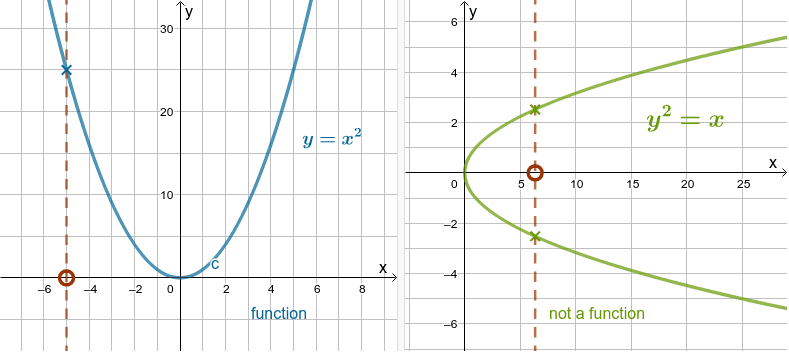
This IS a function
Any vertical line crosses once
This is NOT a function
Some vertical lines cross twice
Why Does This Work?
Remember, a function assigns exactly one output to each input. If a vertical line (representing a single x-value) crosses the graph twice, that means one input has two different outputs, which violates the definition of a function!
Activity 1: Multiple Choice Questions
Test your understanding of function combinations! Select the correct answer for each question.
Question 1 of 5
If and , what is ?
Question 2 of 5
If and , what is ?
Question 3 of 5
If and , what is ?
Question 4 of 5
What is the domain of if ?
Question 5 of 5
If and , what is ?
Activity 2: True or False
Determine whether each statement is true or false.
Statement 1 of 5
for all functions and .
Statement 2 of 5
The domain of excludes all values where .
Statement 3 of 5
A graph passes the vertical line test if every vertical line intersects it at least once.
Statement 4 of 5
for all functions and .
Statement 5 of 5
The domain of is the intersection of the domains of and .
Activity 3: Mixed Challenge
Test your skills with a variety of question types!
Question 1 of 5: Fill in the Blank
If and , then
Question 2 of 5: Multiple Choice
If and , which of the following simplifies ?
Question 3 of 5: Fill in the Blank
The domain of excludes values where
Question 4 of 5: True or False
If a vertical line intersects a graph at exactly two points, the graph represents a function.
Question 5 of 5: Multiple Choice
Given and , what is ?
Lesson Summary
Sum of Functions: — Add the outputs of two functions.
Difference of Functions: — Subtract one function’s output from another. Note: order matters!
Product of Functions: — Multiply the outputs of two functions.
Quotient of Functions: where — Divide one function by another, excluding values where the denominator is zero.
Domain of Combined Functions: For sum, difference, and product, the domain is the intersection of the individual domains. For quotient, exclude values where the denominator equals zero.
Vertical Line Test: A graph represents a function if and only if no vertical line intersects it more than once.
Assessment
Complete this assessment to demonstrate your understanding of function combinations.
Assessment Question 1 of 5
If and , find .
Assessment Question 2 of 5
Given and , what is ?
Assessment Question 3 of 5
If and , find .
Assessment Question 4 of 5
What is the domain of where and ?
Assessment Question 5 of 5
Which graph represents a function according to the vertical line test?
Competency Checklist
Check off each competency as you master it: