
Mathematics Grade 10 11 Sections52 Lessons365 Days
1.5. Types of Function
Mathematics 10th Grade (Ethiopian Curriculum)
Lesson Competencies
At the end of the lesson, you will be able to:
Define and identify one-to-one (injective) functions.
Apply the Horizontal Line Test to determine if a function is one-to-one.
Define and identify onto (surjective) functions.
Define and identify bijective functions (one-to-one correspondence).
Distinguish between different types of functions with examples.
Key Terms
One-to-One (Injective) Function
A function where each element in the range corresponds to exactly one element in the domain. No two different inputs produce the same output.
Horizontal Line Test
A visual test to determine if a function is one-to-one. If any horizontal line intersects the graph more than once, the function is not one-to-one.
Onto (Surjective) Function
A function where every element in the codomain is mapped to by at least one element in the domain. The range equals the codomain.
Bijective Function
A function that is both one-to-one (injective) and onto (surjective). It establishes a perfect one-to-one correspondence between domain and codomain.
Video Lesson
Core Lesson
Introduction
Dear learners,
Imagine you’re organizing a school dance where each student must bring exactly one guest, and each guest can only be invited by one student. This scenario represents a special type of relationship called a one-to-one function! Now, what if we want to ensure that every seat in the hall is filled? That would be an onto function. And if both conditions are met—each student brings one unique guest AND all seats are filled—we have a bijective function!
Today, we’re going to explore different types of functions and learn how to identify them. Understanding these concepts is crucial for advanced mathematics, including calculus and linear algebra.
Brainstorming Scenario
Think about your classroom seating arrangement. If each student sits in exactly one chair and no two students share a chair, is this a function? Is it one-to-one? What if there are empty chairs—is it still onto? Let’s explore!
1. One-to-One (Injective) Functions
Definition
A function is called one-to-one (injective) if different elements in the domain map to different elements in the codomain.
Mathematically: If , then
Or equivalently: If , then
Example 1: One-to-One Function
Consider the function
Let’s check if it’s one-to-one:
Assume
Then
Therefore, is one-to-one!
Example 2: Not One-to-One
Consider the function
Notice that and
Since but , different inputs produce the same output.
Therefore, is NOT one-to-one!
Visual Representation
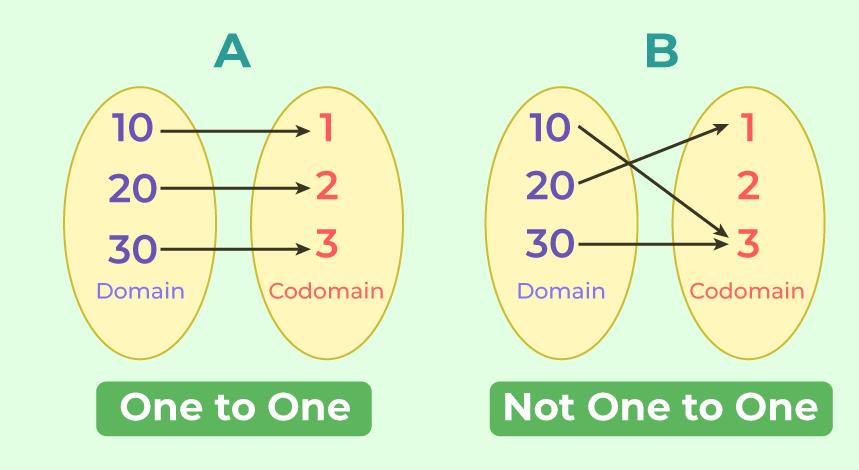
In a one-to-one function, arrows from different domain elements never meet at the same codomain element.
2. The Horizontal Line Test
Definition
The Horizontal Line Test is a visual method to determine if a function is one-to-one:
- Draw horizontal lines across the graph of the function
- If ANY horizontal line intersects the graph MORE THAN ONCE, the function is NOT one-to-one
- If EVERY horizontal line intersects the graph AT MOST ONCE, the function IS one-to-one
Horizontal Line Test Examples

✓ Passes HLT: One-to-One

✗ Fails HLT: Not One-to-One
Example 3: Applying the Horizontal Line Test
Function:
When we draw horizontal lines across the graph of , each line intersects the curve exactly once.
Result: is one-to-one!
Function:
When we draw horizontal lines (especially for ) across the graph of , many lines intersect the V-shape twice.
Result: is NOT one-to-one!
3. Onto (Surjective) Functions
Definition
A function is called onto (surjective) if every element in the codomain is the image of at least one element in the domain .
Mathematically: For every , there exists at least one such that
In other words: Range = Codomain
Example 4: Onto Function
Consider defined by
For any real number , we can find such that :
Since we can always find such an for any , every element in the codomain is covered.
Therefore, is onto!
Example 5: Not Onto
Consider defined by
The range of is (all non-negative real numbers).
However, the codomain is (all real numbers).
For example, there is no real number such that .
Therefore, is NOT onto when the codomain is !
Note: If we change the codomain to , then would be onto.
Visual Representation
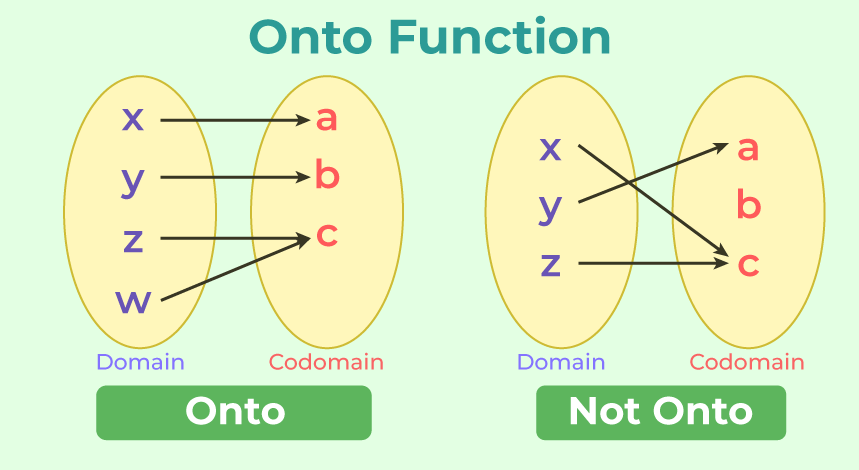
In an onto function, every element in the codomain receives at least one arrow from the domain.
4. One-to-One Correspondence (Bijective Functions)
Definition
A function is called bijective if it is both one-to-one (injective) AND onto (surjective).
A bijective function establishes a perfect pairing between elements of the domain and codomain.
Key property: Bijective functions have inverse functions!
Example 6: Bijective Function
Consider defined by
Checking One-to-One:
If , then
This gives ✓ One-to-one
Checking Onto:
For any , let
Then ✓ Onto
Therefore, is bijective!
Inverse function:
Example 7: Function Properties Summary
| Function | One-to-One? | Onto? | Bijective? |
|---|---|---|---|
| ✓ Yes | ✓ Yes | ✓ Yes | |
| () | ✗ No | ✗ No | ✗ No |
| ✓ Yes | ✓ Yes | ✓ Yes | |
| () | ✓ Yes | ✗ No | ✗ No |
Visual Representation

A bijective function creates a perfect matching: each domain element maps to exactly one unique codomain element, and all codomain elements are covered.
Important Notes
- All bijective functions are both one-to-one and onto
- Only bijective functions have inverse functions
- The composition of two bijective functions is also bijective
- Whether a function is onto depends on how we define the codomain
- Linear functions (where ) are always bijective when mapping
Activity 1: Multiple Choice Questions
Test your understanding of function types with these questions.
Question 1 of 5
Which of the following best describes a one-to-one function?
Question 2 of 5
The function where is:
Question 3 of 5
Which test helps determine if a function is one-to-one?
Question 4 of 5
A bijective function is:
Question 5 of 5
If where , then is:
Activity 2: True or False
Determine whether each statement is true or false.
Question 1 of 5
Every bijective function has an inverse function.
Question 2 of 5
If a function passes the horizontal line test, it is onto.
Question 3 of 5
The function is one-to-one.
Question 4 of 5
An onto function ensures that every element in the codomain is mapped to by at least one element in the domain.
Question 5 of 5
All linear functions of the form where are bijective when mapping from to .
Activity 3: Mixed Challenge
Apply your knowledge with these varied questions.
Question 1 of 5
A function that is both one-to-one and onto is called a ________ function.
Question 2 of 5
Which of these functions is NOT one-to-one?
Question 3 of 5
The ________ Line Test is used to determine if a function is one-to-one.
Question 4 of 5
A function can be onto without being one-to-one.
Question 5 of 5
If is onto, then:
Lesson Summary
A one-to-one (injective) function maps different domain elements to different codomain elements. No two inputs produce the same output.
The Horizontal Line Test determines if a function is one-to-one: if any horizontal line intersects the graph more than once, the function is not one-to-one.
An onto (surjective) function ensures every element in the codomain is mapped to by at least one element in the domain. The range equals the codomain.
A bijective function is both one-to-one and onto, creating a perfect pairing between domain and codomain. Only bijective functions have inverses.
Understanding function types is essential for advanced mathematics, including inverse functions, function composition, and transformations.
Assessment
Complete this assessment to check your mastery of the lesson.
Question 1 of 5
Consider the function defined by . Is this function one-to-one?
Question 2 of 5
Let be defined by . Which statement is correct?
Question 3 of 5
Which property must a function have to possess an inverse function?
Question 4 of 5
If a horizontal line intersects the graph of a function at three different points, what can you conclude?
Question 5 of 5
Consider defined by . What type of function is ?
Competency Checklist
Check off each competency as you master it: