
Chemistry: Grade 10 10 Sections52 Lessons365 Days
1.1. CHEMICAL EQUATIONS
Interactive Chemistry Lesson – Grade 10
Lesson Competencies
At the end of the lesson you will be able to:
Define chemical reaction and give examples of chemical reactions.
Explain the difference between physical and chemical changes using examples.
Write chemical equations using symbols and formulas.
Balance chemical equations using inspection, LCM, and algebraic methods.
Apply balancing techniques to solve complex chemical equation problems.
Key Terms
Chemical Reaction
A process where one or more substances are transformed into different substances with new properties.
Physical Change
A change in appearance or state without forming new substances.
Chemical Change
A change that results in the formation of new substances with different properties.
Chemical Equation
A symbolic representation of a chemical reaction showing reactants and products.
Reactants
Substances that undergo change in a chemical reaction (left side of equation).
Products
New substances formed as a result of a chemical reaction (right side of equation).
Balancing
Adjusting coefficients to ensure equal numbers of each atom on both sides of the equation.
Coefficient
A number placed before a chemical formula to balance an equation.
Video Lesson
Core Lesson
Introduction
Dear learners,
Imagine you’re cooking breakfast. You crack an egg into a hot pan, and something amazing happens – the clear liquid white turns solid and white, and you can smell it cooking. Can you reverse this? Can you turn the cooked egg back into a raw egg? The answer is no! This is because a chemical reaction has occurred.
Think About This:
Have you ever watched fireworks light up the night sky? Or seen rust form on an old bicycle? Have you watched a candle burn or bread dough rise? All of these are examples of chemical reactions happening around us every day! Today, we’re going to explore the fascinating world of chemical reactions and learn how to represent them using chemical equations.
1.1 Introduction to Chemical Reactions
What is a Chemical Reaction?
A chemical reaction is a process in which one or more substances (called reactants) are transformed into one or more different substances (called products). During a chemical reaction, the atoms in the reactants rearrange to form new substances with different properties.
Key Characteristics of Chemical Reactions:
- Formation of new substances with different properties
- Energy changes (heat, light, sound, or electricity)
- Color changes
- Formation of gas (bubbles) or precipitate (solid)
- Usually irreversible or difficult to reverse
Examples of Chemical Reactions:
1. Combustion (Burning)
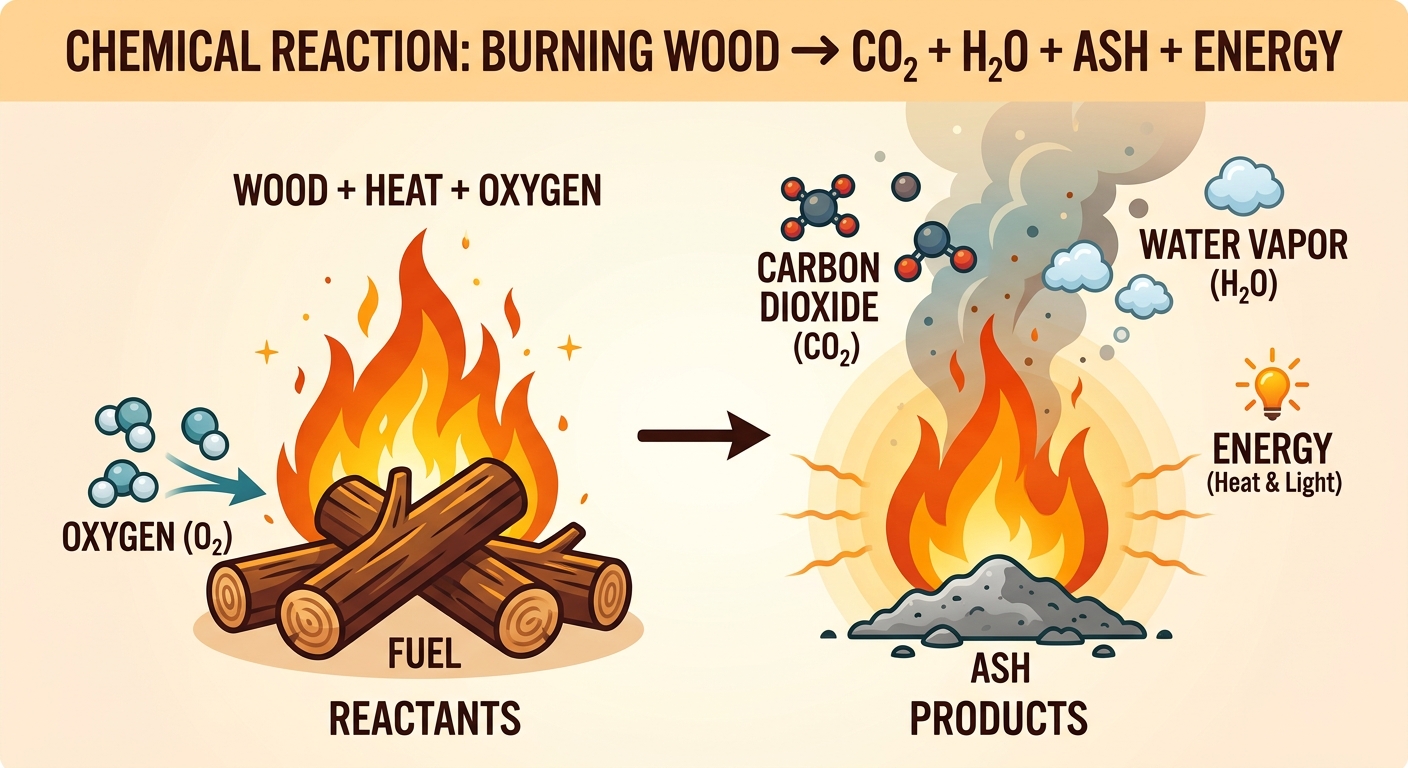
When wood burns, it reacts with oxygen in the air to produce carbon dioxide, water vapor, ash, heat, and light. The wood cannot be recovered.
2. Rusting
Iron reacts with oxygen and water to form iron oxide (rust). The reddish-brown rust is a completely different substance from shiny iron metal.
3. Photosynthesis
Plants use carbon dioxide and water, with sunlight energy, to produce glucose (sugar) and oxygen. This is how plants make their own food.
4. Cooking/Baking
When you bake bread, chemical reactions cause the dough to rise and turn golden brown. The baked bread has different taste, texture, and properties from raw dough.
5. Battery Operation
Chemical reactions inside batteries produce electrical energy. The chemicals react to release electrons, creating an electric current.
6. Digestion
Food is broken down by chemical reactions in your stomach and intestines, converting complex molecules into simpler ones your body can use.
Physical Changes vs. Chemical Changes
It’s important to distinguish between physical changes and chemical changes because they involve different processes.
Physical Changes
A physical change is a change in the form or appearance of a substance, but no new substance is formed. The chemical composition remains the same.
Characteristics of Physical Changes:
- No new substances are formed
- Usually reversible
- Only physical properties change (shape, size, state)
- Chemical composition remains the same
- Energy changes are usually small
Examples of Physical Changes:
Melting Ice
Ice (solid water) → Water (liquid)
Boiling Water
Water (liquid) → Steam (gas)
Dissolving Sugar
Sugar dissolves but doesn’t change
Breaking Glass
Glass breaks into pieces, still glass
Cutting Paper
Paper is smaller but still paper
Freezing Water
Water (liquid) → Ice (solid)
Chemical Changes
A chemical change (or chemical reaction) produces one or more new substances with different properties from the original substances.
Characteristics of Chemical Changes:
- New substances are formed
- Usually irreversible or difficult to reverse
- Chemical properties change
- Energy changes are often significant (heat, light)
- May involve color change, gas production, or precipitate formation
Examples of Chemical Changes:
Burning Paper
Produces ash, smoke, and gases
Cooking an Egg
Proteins change structure permanently
Rusting Iron
Iron + oxygen → iron oxide (rust)
Milk Souring
Bacteria produce lactic acid
Fireworks
Chemicals react producing light/sound
Photosynthesis
CO₂ + water → glucose + oxygen
Quick Comparison Table
| Property | Physical Change | Chemical Change |
|---|---|---|
| New Substance? | No | Yes |
| Reversible? | Usually yes | Usually no |
| Energy Change | Small | Often large |
| Example | Ice melting | Wood burning |
1.2 Chemical Equations
Chemical reactions can be represented using chemical equations. A chemical equation is like a recipe that shows what substances react together (reactants) and what new substances are produced (products).
1.2.1 Writing Chemical Equations
Basic Structure of a Chemical Equation:
Reactants → Products
The arrow (→) means “produces” or “yields”
Example 1: Formation of Water
Word Equation:
Hydrogen + Oxygen → Water
Chemical Equation (using formulas):
H₂ + O₂ → H₂O
Note: This equation is not balanced yet. We’ll learn how to balance it soon!
Steps to Write a Chemical Equation:
Step 1: Write the word equation
Identify reactants and products, write their names with arrow between them
Step 2: Replace names with chemical formulas
Use correct chemical symbols and formulas for each substance
Step 3: Count atoms on each side
Make sure you know how many of each atom type you have
Step 4: Balance the equation
Add coefficients to make atom counts equal on both sides
1.2.2 Balancing Chemical Equations
The Law of Conservation of Mass states that matter cannot be created or destroyed in a chemical reaction. This means the number of atoms of each element must be the same on both sides of the equation.
Why Balance Equations?
Atoms are neither created nor destroyed during a chemical reaction – they just rearrange. A balanced equation shows the correct proportions of reactants and products.
Important Rules for Balancing:
- Never change the subscripts in chemical formulas (that would change the substance!)
- Only add coefficients (numbers in front of formulas)
- Coefficients multiply everything in the formula
- A coefficient of “1” is usually not written
- Check your work by counting atoms on both sides
A. Balancing by Inspection Method (Trial and Error)
This is the most common and intuitive method. You adjust coefficients by looking at the equation and making logical changes.
Example 1: Balancing Hydrogen and Oxygen to Form Water
Unbalanced Equation:
H₂ + O₂ → H₂O
Step 1: Count atoms
Left side (Reactants):
H: 2 atoms
O: 2 atoms
Right side (Products):
H: 2 atoms
O: 1 atom
Oxygen is not balanced!
Step 2: Balance oxygen by adding coefficient 2 to H₂O
H₂ + O₂ → 2H₂O
Step 3: Count atoms again
Left side:
H: 2 atoms
O: 2 atoms
Right side:
H: 4 atoms (2 × 2)
O: 2 atoms (2 × 1)
Now hydrogen is not balanced!
Step 4: Balance hydrogen by adding coefficient 2 to H₂
2H₂ + O₂ → 2H₂O
Step 5: Final check
Left side:
H: 4 atoms (2 × 2)
O: 2 atoms
Right side:
H: 4 atoms (2 × 2)
O: 2 atoms (2 × 1)
Balanced! ✓
Balanced Equation:
2H₂ + O₂ → 2H₂O
Example 2: Combustion of Methane
Unbalanced Equation:
CH₄ + O₂ → CO₂ + H₂O
(Methane burns in oxygen to produce carbon dioxide and water)
Step 1: Count atoms
Reactants:
C: 1, H: 4, O: 2
Products:
C: 1, H: 2, O: 3
Step 2: Balance H by placing 2 before H₂O
CH₄ + O₂ → CO₂ + 2H₂O
Now: C: 1, H: 4, O: 4 on right side
Step 3: Balance O by placing 2 before O₂
CH₄ + 2O₂ → CO₂ + 2H₂O
Now: O: 4 on both sides
Balanced Equation:
CH₄ + 2O₂ → CO₂ + 2H₂O
C: 1, H: 4, O: 4 on both sides ✓
B. Balancing by LCM (Least Common Multiple) Method
This method is useful when dealing with polyatomic ions or when an element appears in multiple compounds. We find the LCM of the number of atoms to determine coefficients.
Example 3: Reaction of Aluminum with Oxygen
Unbalanced Equation:
Al + O₂ → Al₂O₃
Step 1: Count atoms
Reactants: Al = 1, O = 2
Products: Al = 2, O = 3
Step 2: Find LCM for oxygen
O appears as O₂ (reactant) and O₃ (product)
LCM of 2 and 3 = 6
Coefficient for O₂ = 6 ÷ 2 = 3
Coefficient for Al₂O₃ = 6 ÷ 3 = 2
Step 3: Write equation with these coefficients
Al + 3O₂ → 2Al₂O₃
Step 4: Balance Al
Right side has 2 × 2 = 4 Al atoms
Need coefficient 4 for Al on left side
4Al + 3O₂ → 2Al₂O₃
Balanced Equation:
4Al + 3O₂ → 2Al₂O₃
Al: 4, O: 6 on both sides ✓
C. Balancing by Algebraic Method
This systematic method uses algebra to find coefficients. It’s especially useful for complex equations.
Example 4: Combustion of Ethanol (C₂H₅OH)
Unbalanced Equation:
C₂H₅OH + O₂ → CO₂ + H₂O
Step 1: Assign variables as coefficients
aC₂H₅OH + bO₂ → cCO₂ + dH₂O
Step 2: Write equations for each element
Carbon (C): 2a = c
Hydrogen (H): 6a = 2d
Oxygen (O): a + 2b = 2c + d
Step 3: Assign a = 1 (simplest case)
If a = 1:
From C: c = 2(1) = 2
From H: 6(1) = 2d → d = 3
From O: 1 + 2b = 2(2) + 3 → 1 + 2b = 7 → 2b = 6 → b = 3
Step 4: Substitute values
C₂H₅OH + 3O₂ → 2CO₂ + 3H₂O
Balanced Equation:
C₂H₅OH + 3O₂ → 2CO₂ + 3H₂O
Verification: C: 2, H: 6, O: 7 on both sides ✓
Example 5: More Complex Algebraic Method
Unbalanced Equation:
Fe + H₂O → Fe₃O₄ + H₂
Step 1: Assign variables
aFe + bH₂O → cFe₃O₄ + dH₂
Step 2: Set up equations
Fe: a = 3c
H: 2b = 2d → b = d
O: b = 4c
Step 3: Let c = 1
From Fe: a = 3(1) = 3
From O: b = 4(1) = 4
From H: d = b = 4
Balanced Equation:
3Fe + 4H₂O → Fe₃O₄ + 4H₂
Fe: 3, H: 8, O: 4 on both sides ✓
Tips for Success in Balancing:
- Start with the most complex molecule or the element that appears least frequently
- Balance polyatomic ions as a unit if they appear on both sides unchanged
- Leave elements that appear alone (like O₂, H₂) for last
- Use fractions if needed, then multiply all coefficients to get whole numbers
- Always check your final answer by counting atoms on both sides
- Practice makes perfect – the more you balance, the easier it becomes!
Worked Examples
Worked Example 1: Identifying Chemical vs Physical Changes
Question:
Classify each of the following as a physical or chemical change:
- Cutting a piece of paper
- Burning a piece of paper
- Dissolving salt in water
- Rusting of an iron nail
Solution:
1. Cutting paper – Physical change
Reason: The paper is still paper, just in smaller pieces. No new substance formed.
2. Burning paper – Chemical change
Reason: Paper is converted to ash, smoke, and gases. New substances with different properties are formed. Cannot be reversed.
3. Dissolving salt – Physical change
Reason: Salt molecules spread out in water but remain salt. Can be recovered by evaporating the water. No new substance formed.
4. Rusting – Chemical change
Reason: Iron reacts with oxygen to form iron oxide (rust), a completely different substance with different properties. Cannot be easily reversed.
Worked Example 2: Writing Chemical Equations
Question:
Write the word equation and chemical equation for: Magnesium burns in oxygen to form magnesium oxide.
Solution:
Step 1: Word Equation
Magnesium + Oxygen → Magnesium oxide
Step 2: Write chemical formulas
- Magnesium = Mg
- Oxygen = O₂ (diatomic molecule)
- Magnesium oxide = MgO
Step 3: Unbalanced equation
Mg + O₂ → MgO
Step 4: Balance the equation
Count atoms: Left (Mg: 1, O: 2), Right (Mg: 1, O: 1) – O not balanced
Add coefficient 2 to MgO: Mg + O₂ → 2MgO
Now Mg not balanced. Add coefficient 2 to Mg: 2Mg + O₂ → 2MgO
Final Balanced Equation:
2Mg + O₂ → 2MgO
Verification: Mg: 2, O: 2 on both sides ✓
Worked Example 3: Balancing Using LCM Method
Question:
Balance the equation: N₂ + H₂ → NH₃
Solution:
Step 1: Count atoms
Reactants: N = 2, H = 2
Products: N = 1, H = 3
Step 2: Find LCM for nitrogen
N appears as N₂ (reactant) and N (product, 1 atom)
LCM of 2 and 1 = 2
Coefficient for NH₃ = 2 ÷ 1 = 2
N₂ + H₂ → 2NH₃
Step 3: Balance hydrogen
Right side now has 2 × 3 = 6 H atoms
Need coefficient 3 for H₂ on left: 6 ÷ 2 = 3
N₂ + 3H₂ → 2NH₃
Balanced Equation:
N₂ + 3H₂ → 2NH₃
N: 2, H: 6 on both sides ✓
Worked Example 4: Balancing Using Algebraic Method
Question:
Balance the equation: C₃H₈ + O₂ → CO₂ + H₂O (Combustion of propane)
Solution:
Step 1: Assign variables
aC₃H₈ + bO₂ → cCO₂ + dH₂O
Step 2: Set up equations for each element
C: 3a = c
H: 8a = 2d
O: 2b = 2c + d
Step 3: Let a = 1 and solve
From C: c = 3(1) = 3
From H: 8(1) = 2d → d = 4
From O: 2b = 2(3) + 4 = 10 → b = 5
Balanced Equation:
C₃H₈ + 5O₂ → 3CO₂ + 4H₂O
C: 3, H: 8, O: 10 on both sides ✓
Interactive Activity 1: Multiple Choice Questions
Interactive Activity 2: True or False
Interactive Activity 3: Mixed Challenge
Lesson Summary
A chemical reaction is a process where substances (reactants) are transformed into new substances (products) with different properties.
Physical changes alter appearance without forming new substances (reversible), while chemical changes create new substances with different properties (usually irreversible).
Chemical equations represent reactions using symbols and formulas, showing reactants on the left and products on the right, separated by an arrow.
Balancing equations ensures the Law of Conservation of Mass is obeyed – the same number of each type of atom must appear on both sides.
Three methods for balancing: Inspection (trial and error), LCM (using least common multiples), and Algebraic (using variables and equations).
Never change subscripts in formulas when balancing – only adjust coefficients in front of formulas.
Assessment
Competency Checklist
Check off each competency as you master it: