
Chemistry: Grade 10 10 Sections52 Lessons365 Days
1.5 : Chemical Formulas – Empirical and Molecular Formula
CHEMISTRY FOR GRADE 10 – Interactive Lesson
Lesson Competencies
At the end of the lesson you will be able to:
Define empirical and molecular formulas clearly and accurately.
Calculate the percentage composition of elements in chemical compounds.
Determine empirical formulas from percentage composition or mass data.
Determine molecular formulas from empirical formulas and molecular mass.
Apply mathematical concepts to solve chemical formula problems.
Key Terms
Empirical Formula
The simplest whole-number ratio of atoms of each element in a compound.
Molecular Formula
The actual number of atoms of each element in one molecule of a compound.
Percentage Composition
The percentage by mass of each element in a compound.
Molar Mass
The mass of one mole of a substance, expressed in grams per mole (g/mol).
Mole
A unit representing 6.022 × 10²³ particles (Avogadro’s number).
Chemical Formula
A representation of a substance using symbols for its constituent elements.
Video Lesson
Core Lesson
Introduction
Dear learners,
Imagine you are a detective trying to identify an unknown white powder found at a crime scene. Is it sugar? Salt? Or something else? Chemists face similar challenges every day! They need to determine not just what elements are in a substance, but exactly how many atoms of each element are present. This is where chemical formulas come in!
Today, we’ll explore two important types of chemical formulas: empirical formulas and molecular formulas. We’ll also learn how to calculate the percentage composition of compounds and how to determine these formulas from experimental data. By the end of this lesson, you’ll be able to decode the chemical identity of substances just like a professional chemist!
Think About This!
You have two different compounds: hydrogen peroxide (H₂O₂) used for cleaning wounds, and water (H₂O) that we drink. Both contain only hydrogen and oxygen atoms. What makes them different? The answer lies in their chemical formulas!
Part 1: Understanding Chemical Formulas
What is a Chemical Formula?
A chemical formula is a symbolic representation of a compound that shows:
- The elements present in the compound (using element symbols)
- The number of atoms of each element (using subscripts)
For example: H₂O tells us that water contains 2 hydrogen atoms and 1 oxygen atom.
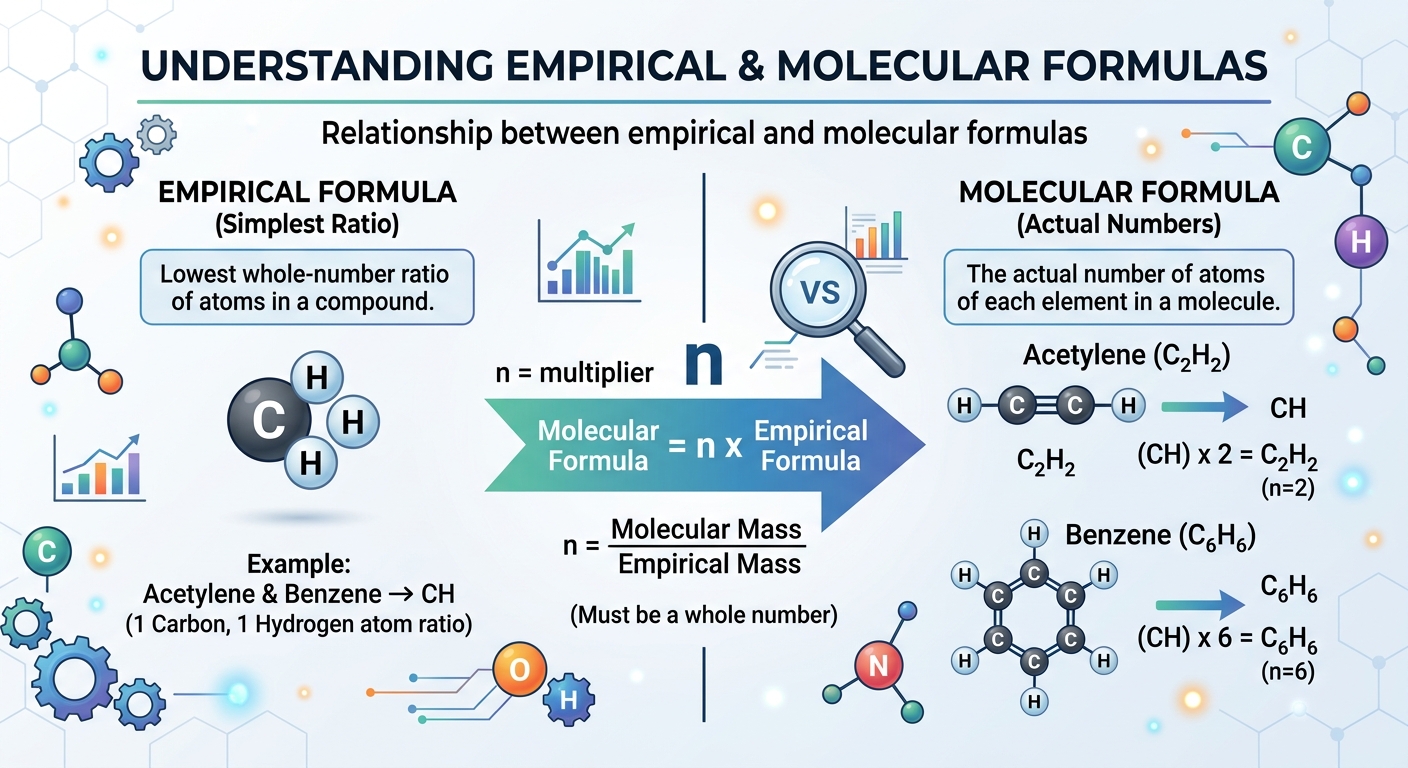
1. Empirical Formula
The empirical formula shows the simplest whole-number ratio of atoms of each element in a compound.
Example: Glucose has the molecular formula C₆H₁₂O₆. The ratio of C:H:O is 6:12:6, which simplifies to 1:2:1. Therefore, the empirical formula is CH₂O.
Key Point: The empirical formula gives the simplest ratio, not necessarily the actual number of atoms in a molecule.
2. Molecular Formula
The molecular formula shows the actual number of atoms of each element in one molecule of a compound.
Example: The molecular formula of glucose is C₆H₁₂O₆, which tells us that one molecule of glucose contains exactly 6 carbon atoms, 12 hydrogen atoms, and 6 oxygen atoms.
Relationship: Molecular Formula = (Empirical Formula) × n, where n is a whole number.
For glucose: C₆H₁₂O₆ = (CH₂O) × 6
Comparing Empirical and Molecular Formulas
| Compound | Molecular Formula | Empirical Formula |
|---|---|---|
| Water | H₂O | H₂O |
| Hydrogen Peroxide | H₂O₂ | HO |
| Glucose | C₆H₁₂O₆ | CH₂O |
| Ethane | C₂H₆ | CH₃ |
Notice: Sometimes the empirical formula and molecular formula are the same (like water), but often they are different!
Part 2: Percentage Composition of Compounds
What is Percentage Composition?
The percentage composition tells us what percentage of the total mass of a compound is made up by each element.
Formula:
% of element = (Mass of element in compound / Total molar mass of compound) × 100%
Steps to Calculate Percentage Composition:
- Write the chemical formula of the compound
- Calculate the molar mass of the compound
- Calculate the total mass of each element in the formula
- Divide the mass of each element by the total molar mass
- Multiply by 100 to get the percentage
Worked Example 1: Percentage Composition of Water (H₂O)
Given: Atomic masses: H = 1 g/mol, O = 16 g/mol
Step 1: Calculate the molar mass of H₂O
Molar mass = (2 × 1) + (1 × 16) = 2 + 16 = 18 g/mol
Step 2: Calculate the percentage of hydrogen
Mass of H in H₂O = 2 × 1 = 2 g/mol
% H = (2/18) × 100% = 11.11%
Step 3: Calculate the percentage of oxygen
Mass of O in H₂O = 1 × 16 = 16 g/mol
% O = (16/18) × 100% = 88.89%
Answer: Water is 11.11% hydrogen and 88.89% oxygen by mass.
Check: 11.11% + 88.89% = 100% ✓
Worked Example 2: Percentage Composition of Carbon Dioxide (CO₂)
Given: Atomic masses: C = 12 g/mol, O = 16 g/mol
Step 1: Calculate the molar mass of CO₂
Molar mass = (1 × 12) + (2 × 16) = 12 + 32 = 44 g/mol
Step 2: Calculate the percentage of carbon
Mass of C in CO₂ = 1 × 12 = 12 g/mol
% C = (12/44) × 100% = 27.27%
Step 3: Calculate the percentage of oxygen
Mass of O in CO₂ = 2 × 16 = 32 g/mol
% O = (32/44) × 100% = 72.73%
Answer: Carbon dioxide is 27.27% carbon and 72.73% oxygen by mass.
Part 3: Determining Empirical Formulas
How to Determine Empirical Formulas
When chemists analyze an unknown compound, they can determine what percentage of each element it contains. From this data, we can calculate the empirical formula.
Steps to Determine Empirical Formula:
- Convert percentages to grams (assume 100 g of compound)
- Convert grams to moles (divide by atomic mass)
- Divide by the smallest number of moles to get ratios
- Multiply to get whole numbers (if needed)
- Write the empirical formula
Worked Example 3: Finding Empirical Formula from Percentage
Problem: A compound contains 40% carbon, 6.7% hydrogen, and 53.3% oxygen. Find its empirical formula.
Given: Atomic masses: C = 12 g/mol, H = 1 g/mol, O = 16 g/mol
Step 1: Assume 100 g of compound (so percentages = grams)
C: 40 g
H: 6.7 g
O: 53.3 g
Step 2: Convert grams to moles
Moles of C = 40 ÷ 12 = 3.33 mol
Moles of H = 6.7 ÷ 1 = 6.7 mol
Moles of O = 53.3 ÷ 16 = 3.33 mol
Step 3: Divide by the smallest number of moles (3.33)
C: 3.33 ÷ 3.33 = 1
H: 6.7 ÷ 3.33 = 2.01 ≈ 2
O: 3.33 ÷ 3.33 = 1
Step 4: The ratios are already whole numbers
C:H:O = 1:2:1
Answer: The empirical formula is CH₂O
Worked Example 4: Empirical Formula from Mass Data
Problem: A compound contains 4.8 g of carbon and 1.6 g of oxygen. Find its empirical formula.
Given: Atomic masses: C = 12 g/mol, O = 16 g/mol
Step 1: Convert grams to moles
Moles of C = 4.8 ÷ 12 = 0.4 mol
Moles of O = 1.6 ÷ 16 = 0.1 mol
Step 2: Divide by the smallest number of moles (0.1)
C: 0.4 ÷ 0.1 = 4
O: 0.1 ÷ 0.1 = 1
Step 3: Write the empirical formula
Answer: The empirical formula is C₄O
Important Note: When Ratios Are Not Whole Numbers
Sometimes after dividing by the smallest number, you get decimal ratios like 1:1.5:2. In this case, multiply all ratios by a factor to get whole numbers:
- If ratios end in .5 → multiply by 2
- If ratios end in .33 or .67 → multiply by 3
- If ratios end in .25 or .75 → multiply by 4
Example: If you get C:H:O = 1:1.5:1, multiply all by 2 → C₂H₃O₂
Part 4: Determining Molecular Formula from Empirical Formula
From Empirical to Molecular Formula
Once we know the empirical formula and the molar mass of the compound, we can find the molecular formula.
Formula:
n = Molar mass of compound / Molar mass of empirical formula
Molecular formula = (Empirical formula) × n
Steps:
- Calculate the molar mass of the empirical formula
- Divide the given molar mass by the empirical formula mass
- Multiply the subscripts in the empirical formula by this value (n)
Worked Example 5: Finding Molecular Formula
Problem: A compound has an empirical formula of CH₂O and a molar mass of 180 g/mol. Find its molecular formula.
Given: Atomic masses: C = 12 g/mol, H = 1 g/mol, O = 16 g/mol
Step 1: Calculate the molar mass of the empirical formula (CH₂O)
Empirical formula mass = 12 + (2 × 1) + 16 = 12 + 2 + 16 = 30 g/mol
Step 2: Calculate n
n = Molar mass ÷ Empirical formula mass
n = 180 ÷ 30 = 6
Step 3: Multiply the empirical formula by n
Molecular formula = (CH₂O) × 6
Molecular formula = C₆H₁₂O₆
Answer: The molecular formula is C₆H₁₂O₆ (this is glucose!)
Worked Example 6: Complete Problem
Problem: A hydrocarbon (compound of C and H only) contains 85.7% carbon and 14.3% hydrogen. Its molar mass is 84 g/mol. Find its empirical and molecular formulas.
Given: Atomic masses: C = 12 g/mol, H = 1 g/mol
Part A: Finding Empirical Formula
Step 1: Assume 100 g of compound
C: 85.7 g
H: 14.3 g
Step 2: Convert to moles
Moles of C = 85.7 ÷ 12 = 7.14 mol
Moles of H = 14.3 ÷ 1 = 14.3 mol
Step 3: Divide by smallest (7.14)
C: 7.14 ÷ 7.14 = 1
H: 14.3 ÷ 7.14 = 2
Empirical formula: CH₂
Part B: Finding Molecular Formula
Step 4: Calculate empirical formula mass
Mass of CH₂ = 12 + (2 × 1) = 14 g/mol
Step 5: Calculate n
n = 84 ÷ 14 = 6
Step 6: Find molecular formula
Molecular formula = (CH₂) × 6 = C₆H₁₂
Final Answer:
Empirical formula: CH₂
Molecular formula: C₆H₁₂
Interactive Activity 1: Multiple Choice Questions
Test your understanding of empirical and molecular formulas. Select the correct answer for each question.
Interactive Activity 2: True or False
Determine whether each statement is true or false.
Interactive Activity 3: Mixed Challenge
Apply your knowledge with these varied questions including calculations and fill-in-the-blank.
Lesson Summary
In this lesson, we explored the essential concepts of chemical formulas:
Empirical Formula represents the simplest whole-number ratio of atoms in a compound. It may or may not be the same as the molecular formula.
Molecular Formula shows the actual number of atoms of each element in one molecule of a compound. It is always a whole-number multiple of the empirical formula.
Percentage Composition tells us what percentage of a compound’s mass comes from each element. It can be calculated using: % element = (mass of element / total molar mass) × 100%
Determining Empirical Formulas: Convert percentages to grams (assume 100 g) → convert to moles → divide by smallest → multiply to get whole numbers if needed.
Finding Molecular Formulas: Calculate n = (molar mass of compound) / (molar mass of empirical formula), then multiply the empirical formula by n.
Remember: Chemistry is all about patterns and relationships. Understanding these formulas helps us identify substances and predict their behavior!
Assessment
Complete this assessment to check your understanding of the entire lesson.
Competency Checklist
Check off each competency as you master it: