
Chemistry: Grade 10 10 Sections52 Lessons365 Days
1.2: TYPES OF CHEMICAL REACTIONS
Interactive Chemistry Lesson – Grade 10
Lesson Competencies
At the end of the lesson you will be able to:
List the four types of chemical reactions
Define combination reaction and give examples
Define decomposition reaction and give examples
Define single-displacement reaction and give examples
Define double-displacement reaction and give examples
Conduct experiments on different types of chemical reactions in groups
Classify chemical reactions based on their characteristics
Key Terms
Chemical Reaction
A process in which one or more substances are changed into one or more new substances with different properties.
Combination Reaction
A reaction where two or more reactants combine to form a single product (A + B → AB).
Decomposition Reaction
A reaction where a single compound breaks down into two or more simpler substances (AB → A + B).
Single Displacement
A reaction where one element replaces another in a compound (A + BC → AC + B).
Double Displacement
A reaction where two compounds exchange ions or elements (AB + CD → AD + CB).
Reactant
A substance that takes part in and undergoes change during a chemical reaction.
Product
A substance that is formed as the result of a chemical reaction.
Precipitate
A solid substance that forms and separates from a liquid mixture during a chemical reaction.
Video Lesson
Core Lesson
Introduction
Dear learners,
Have you ever wondered what happens when you light a candle, cook food, or watch fireworks explode in the sky? All these amazing events involve chemical reactions! A chemical reaction is a process where substances change into new substances with completely different properties.
Think About This!
Imagine you’re helping your family prepare dinner. You light the stove, and suddenly the gas bursts into flame. You add baking soda to dough, and it rises. You mix vinegar with baking soda for cleaning, and it fizzes vigorously! Are all these reactions the same? Or are there different types?
Today, we’re going to explore the fascinating world of chemical reactions and learn how scientists classify them into four main types. Understanding these patterns will help you predict what will happen in chemical reactions and explain everyday phenomena around you!
What is a Chemical Reaction?
A chemical reaction occurs when chemical bonds between atoms are broken and new bonds are formed, creating new substances. The substances you start with are called reactants, and the new substances formed are called products.
Reactants → Products
The arrow means “produces” or “yields”
Classification of Chemical Reactions
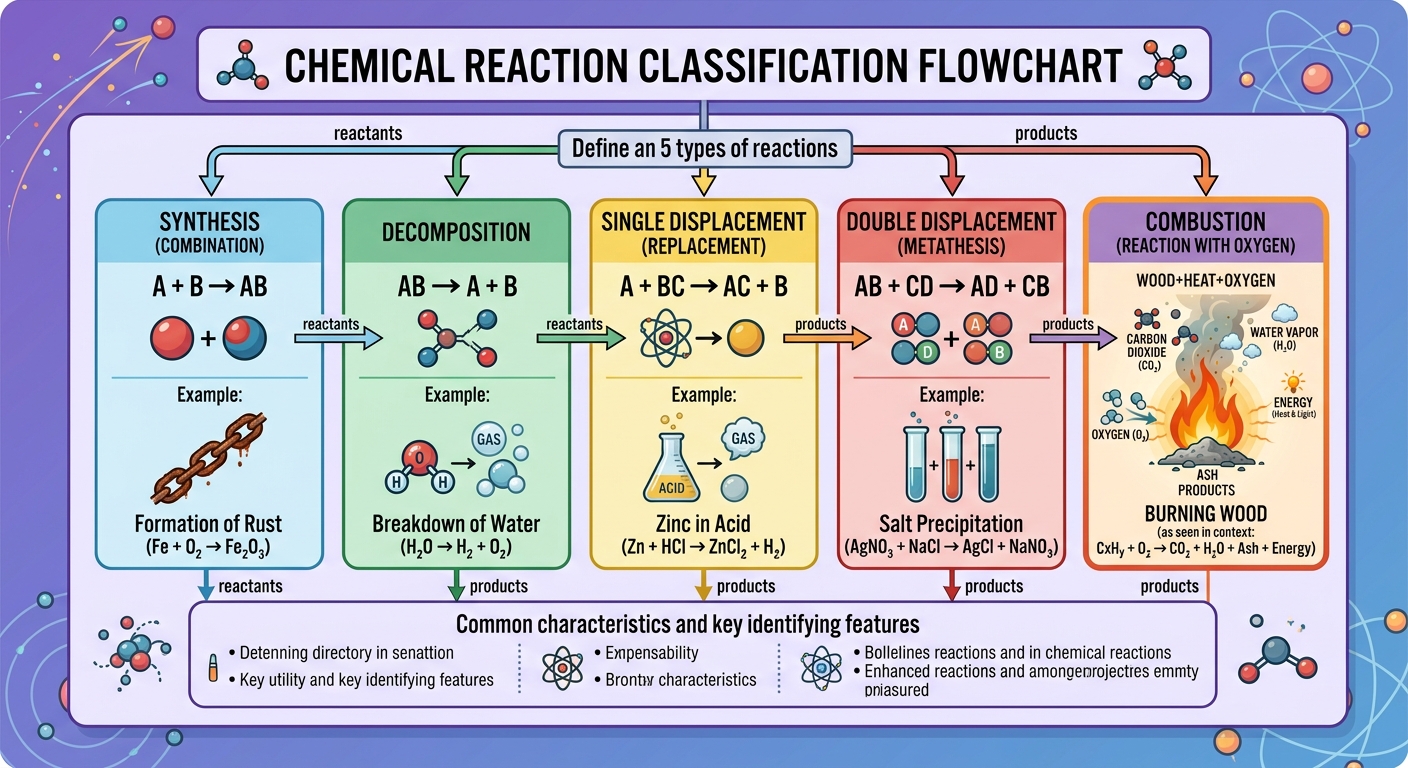
Scientists classify chemical reactions into four main types based on how atoms are rearranged:
Combination
A + B → AB
Decomposition
AB → A + B
Single Displacement
A + BC → AC + B
Double Displacement
AB + CD → AD + CB
A. Direct Combination Reactions (Synthesis Reactions)
In a combination reaction, two or more simple substances (elements or compounds) combine to form a more complex product. This is also called a synthesis reaction.
General Form:
A + B → AB
Two or more reactants combine to form one product
Examples:
1. Formation of Water:
2H₂ + O₂ → 2H₂O
Hydrogen gas combines with oxygen gas to form water.
2. Formation of Ammonia:
N₂ + 3H₂ → 2NH₃
Nitrogen gas combines with hydrogen gas to produce ammonia.
3. Formation of Calcium Oxide:
2Ca + O₂ → 2CaO
Calcium metal burns in oxygen to form calcium oxide (quicklime).
4. Formation of Sodium Chloride:
2Na + Cl₂ → 2NaCl
Sodium metal reacts vigorously with chlorine gas to form table salt.
Laboratory Safety Note:
Many combination reactions are highly exothermic (release heat). Always wear safety goggles and conduct experiments under teacher supervision!
B. Decomposition Reactions (Analysis Reactions)
In a decomposition reaction, a single compound breaks down into two or more simpler substances (elements or simpler compounds). This is the opposite of a combination reaction and often requires energy input (heat, light, or electricity).
General Form:
AB → A + B
One compound breaks down into two or more products
Examples:
1. Decomposition of Water (Electrolysis):
2H₂O → 2H₂ + O₂
Electric current breaks water into hydrogen and oxygen gases.
2. Decomposition of Calcium Carbonate:
CaCO₃ → CaO + CO₂
Heating limestone produces quicklime and carbon dioxide gas.
3. Decomposition of Hydrogen Peroxide:
2H₂O₂ → 2H₂O + O₂
Hydrogen peroxide breaks down into water and oxygen (used for disinfection).
4. Decomposition of Mercury(II) Oxide:
2HgO → 2Hg + O₂
Red mercury oxide decomposes when heated to form liquid mercury and oxygen.
Types of Decomposition:
- Thermal decomposition: Requires heat (e.g., CaCO₃)
- Electrolytic decomposition: Requires electricity (e.g., H₂O)
- Photolytic decomposition: Requires light (e.g., AgBr in photography)
C. Single Displacement Reactions (Single Replacement)
In a single displacement reaction, one element replaces another element in a compound. A more reactive element displaces a less reactive one from its compound.
General Form:
A + BC → AC + B
Element A replaces element B in the compound BC
Examples:
1. Zinc Displacing Copper:
Zn + CuSO₄ → ZnSO₄ + Cu
Zinc metal displaces copper from copper sulfate solution (blue solution becomes colorless).
2. Iron Displacing Copper:
Fe + CuSO₄ → FeSO₄ + Cu
Iron nail placed in copper sulfate solution gets coated with copper.
3. Magnesium Displacing Hydrogen:
Mg + 2HCl → MgCl₂ + H₂
Magnesium reacts with hydrochloric acid, producing hydrogen gas bubbles.
4. Chlorine Displacing Bromine:
Cl₂ + 2NaBr → 2NaCl + Br₂
Chlorine gas displaces bromine from sodium bromide solution.
Activity Series Concept:
The activity series ranks metals by their reactivity. A metal higher in the series can displace one lower in the series:
K > Na > Ca > Mg > Al > Zn > Fe > Pb > H > Cu > Ag > Au
(Most reactive → Least reactive)
D. Double Displacement Reactions (Double Replacement)
In a double displacement reaction, two compounds exchange ions or elements to form two new compounds. The positive ions (cations) and negative ions (anions) switch partners.
General Form:
AB + CD → AD + CB
A and C exchange places, forming two new compounds
Examples:
1. Precipitation Reaction:
AgNO₃ + NaCl → AgCl + NaNO₃
Silver nitrate and sodium chloride form white silver chloride precipitate.
2. Neutralization Reaction:
HCl + NaOH → NaCl + H₂O
Acid and base react to form salt and water (neutralization).
3. Formation of Calcium Carbonate:
CaCl₂ + Na₂CO₃ → CaCO₃ + 2NaCl
White calcium carbonate precipitate forms immediately.
4. Formation of Lead Iodide:
Pb(NO₃)₂ + 2KI → PbI₂ + 2KNO₃
Bright yellow lead iodide precipitate forms (called “golden rain”).
Signs of Double Displacement:
- Formation of a precipitate (solid that settles out)
- Formation of water (in neutralization reactions)
- Formation of a gas (bubbles)
Worked Examples
Example 1: Identify the Reaction Type
Question: What type of reaction is this?
2Mg + O₂ → 2MgO
Solution:
Step 1: Count the reactants: 2 (Mg and O₂)
Step 2: Count the products: 1 (MgO)
Step 3: Pattern: Two substances combine to form one product
Answer: This is a Combination Reaction
Example 2: Complete the Equation
Question: Complete and balance: 2KClO₃ → ?
Solution:
Step 1: Recognize this is a decomposition (one compound breaking down)
Step 2: KClO₃ breaks into KCl and O₂
Step 3: Balance the equation
2KClO₃ → 2KCl + 3O₂
This is a thermal decomposition reaction used to produce oxygen in laboratories.
Example 3: Predict the Products
Question: Predict the products when aluminum reacts with copper sulfate solution.
Solution:
Step 1: Identify: Al is more reactive than Cu (check activity series)
Step 2: Al will displace Cu from CuSO₄
Step 3: Al takes SO₄, Cu is released
Step 4: Balance the equation
2Al + 3CuSO₄ → Al₂(SO₄)₃ + 3Cu
This is a single displacement reaction. You’ll observe reddish copper metal forming!
Example 4: Neutralization Reaction
Question: Write the balanced equation for the reaction between sulfuric acid and potassium hydroxide.
Solution:
Step 1: Write formulas: H₂SO₄ (acid) + KOH (base)
Step 2: Products: Salt (K₂SO₄) + Water (H₂O)
Step 3: Balance the equation
H₂SO₄ + 2KOH → K₂SO₄ + 2H₂O
This is a double displacement (neutralization) reaction – acid + base → salt + water.
Example 5: Identifying Multiple Reaction Types
Question: Classify each reaction:
a) C + O₂ → CO₂
Combination (2 reactants → 1 product)
b) CuO + H₂ → Cu + H₂O
Single Displacement (H replaces Cu)
c) 2H₂O₂ → 2H₂O + O₂
Decomposition (1 reactant → 2 products)
d) BaCl₂ + Na₂SO₄ → BaSO₄ + 2NaCl
Double Displacement (ions exchange partners)
Quick Reference Table
| Reaction Type | General Form | Example | Key Characteristic |
|---|---|---|---|
| Combination | A + B → AB | 2H₂ + O₂ → 2H₂O | Two or more → One |
| Decomposition | AB → A + B | 2H₂O → 2H₂ + O₂ | One → Two or more |
| Single Displacement | A + BC → AC + B | Zn + CuSO₄ → ZnSO₄ + Cu | One element replaces another |
| Double Displacement | AB + CD → AD + CB | AgNO₃ + NaCl → AgCl + NaNO₃ | Two compounds exchange parts |
Interactive Simulation
Explore chemical reactions interactively! Try balancing equations and observing different reaction types.
Interactive Activity 1: Multiple Choice Questions
Test your understanding of chemical reaction types. Select the best answer for each question.
Question 1 of 5
Which type of reaction is represented by: 2Na + Cl₂ → 2NaCl?
Question 2 of 5
What type of reaction requires energy input to break down a compound?
Question 3 of 5
In the reaction Zn + CuSO₄ → ZnSO₄ + Cu, which element is being displaced?
Question 4 of 5
Which reaction produces a white precipitate when silver nitrate reacts with sodium chloride?
Question 5 of 5
Which general equation represents a combination reaction?
Interactive Activity 2: True or False
Determine if each statement is true or false about chemical reactions.
Statement 1 of 5
In a combination reaction, two or more substances combine to form a single product.
Statement 2 of 5
Decomposition reactions always occur spontaneously without any energy input.
Statement 3 of 5
In a single displacement reaction, a more reactive element displaces a less reactive element from a compound.
Statement 4 of 5
Double displacement reactions can produce precipitates, water, or gases.
Statement 5 of 5
The general form AB → A + B represents a combination reaction.
Interactive Activity 3: Mixed Challenge
Test your skills with various question types!
Question 1 of 5: Fill in the Blank
A reaction occurs when a single compound breaks down into two or more simpler substances.
Question 2 of 5: Multiple Choice
Which equation represents a single displacement reaction?
Question 3 of 5: Fill in the Blank
The general form of a double displacement reaction is AB + CD → + CB.
Question 4 of 5: Short Answer
What type of reaction is represented by: 2HgO → 2Hg + O₂?
Question 5 of 5: Multiple Choice
Which metal can displace copper from copper sulfate solution?
Lesson Summary
Chemical reactions can be classified into four main types based on how atoms are rearranged:
1. Combination Reactions (A + B → AB): Two or more substances combine to form a single product. Example: 2H₂ + O₂ → 2H₂O
2. Decomposition Reactions (AB → A + B): A single compound breaks down into two or more simpler substances, usually requiring energy. Example: 2H₂O → 2H₂ + O₂
3. Single Displacement Reactions (A + BC → AC + B): A more reactive element displaces a less reactive element from a compound. Example: Zn + CuSO₄ → ZnSO₄ + Cu
4. Double Displacement Reactions (AB + CD → AD + CB): Two compounds exchange ions or elements, often producing precipitates, water, or gases. Example: AgNO₃ + NaCl → AgCl + NaNO₃
Understanding these reaction types helps us predict products, balance equations, and explain everyday chemical phenomena from rusting iron to digesting food!
Final Assessment
Test your overall understanding of types of chemical reactions.
Assessment Question 1 of 5
Classify the following reaction: 2KClO₃ → 2KCl + 3O₂
Assessment Question 2 of 5
Which of the following is an example of a neutralization reaction?
Assessment Question 3 of 5
In the activity series, which metal is MORE reactive than copper?
Assessment Question 4 of 5
What is produced when calcium carbonate (CaCO₃) undergoes thermal decomposition?
Assessment Question 5 of 5
Which type of reaction typically produces a precipitate?
Competency Checklist
Check off the competencies you have mastered:
Congratulations on completing this lesson!
Keep practicing and exploring chemical reactions in your daily life!