
Chemistry: Grade 10 10 Sections52 Lessons365 Days
1.4. Molecular Masses and the Mole Concept
Molecular and Formula Masses, the Mole Concept
Chemistry for Grade 10
Lesson Competencies
At the end of the lesson you will be able to:
Key Terms
Molecular Mass (M.M)
The sum of the atomic masses of all atoms in a molecule.
Formula Mass (F.M)
The sum of atomic masses of ions in an ionic compound’s formula unit.
The Mole (mol)
SI unit for amount of substance. Contains Avogadro’s number of particles.
Avogadro’s Number
6.022 × 10²³. The number of particles in exactly one mole of a substance.
Molar Mass
The mass of one mole of a substance (g/mol). Numerically equal to atomic mass.
Formulas
Empirical: Simplest ratio. Molecular: Actual number of atoms.
Video Lesson
Core Lesson
Introduction
Dear learners,
Imagine you want to buy rice. You don’t count every single grain of rice, right? That would take forever!
Instead, you buy rice by the kilogram. In chemistry, atoms are so tiny that counting them individually is
impossible. We need a way to count atoms by weighing them in groups. This is where the
Mole Concept comes in—it acts like a “chemist’s dozen” to help us count atoms by weighing
them!
1. Molecular Mass (M.M) and Formula Mass (F.M)
Molecular Mass is the sum of the atomic masses of all the atoms in a molecule. It is typically used for covalent compounds (like water, CO₂).
Formula Mass is the sum of the atomic masses of the ions as represented by the formula unit of an ionic compound (like NaCl).
Calculated by adding the atomic mass (from Periodic Table) multiplied by the subscript for each element.
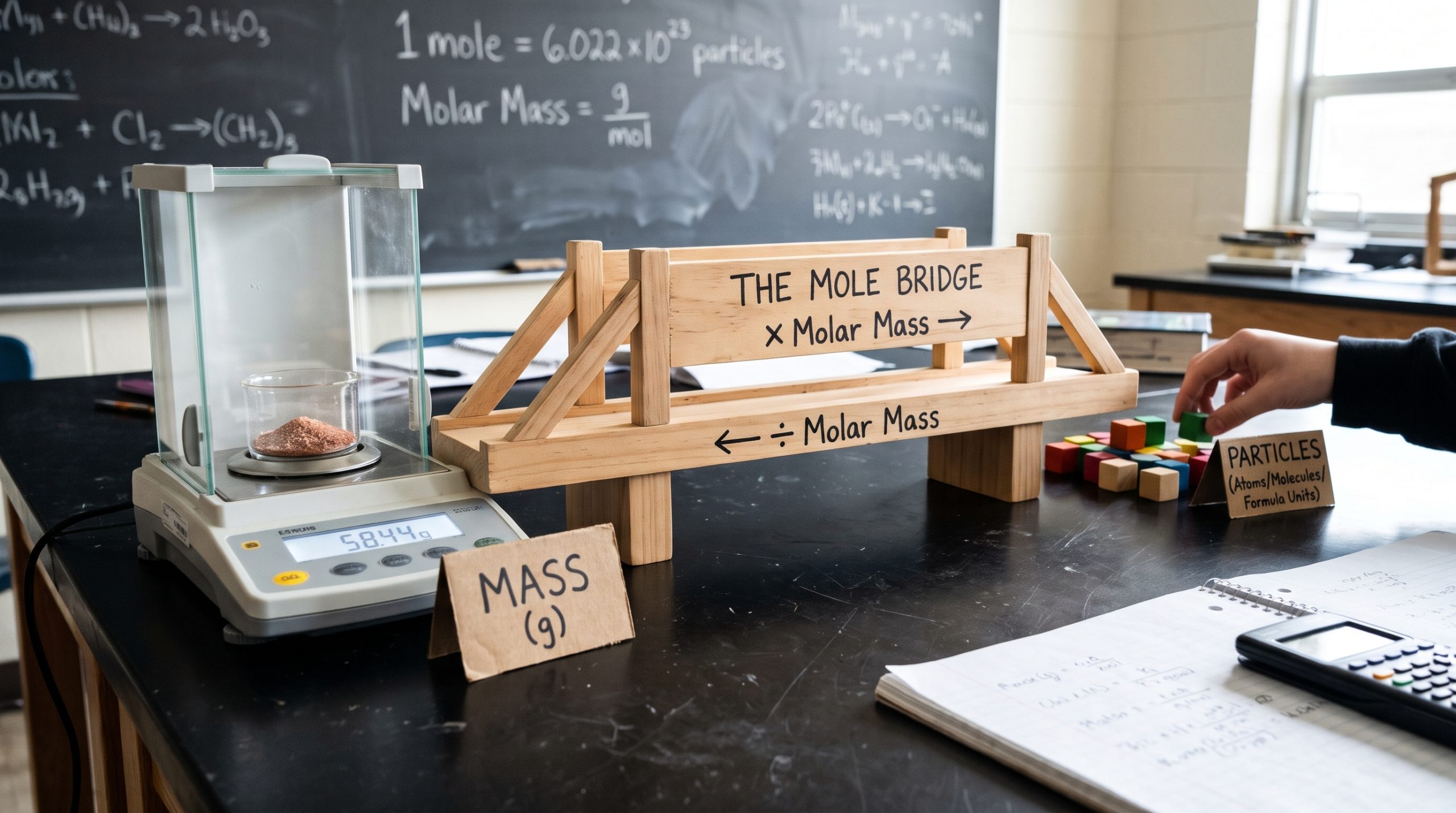
2. The Mole Concept
A mole is the amount of substance that contains as many elementary entities (atoms, molecules, ions) as there are atoms in exactly 12g of Carbon-12.
This huge number is called Avogadro’s Number (Nₐ).
3. Molar Mass
Molar Mass is the mass of one mole of a substance. The unit is grams per mole (g/mol).
- For an element, Molar Mass = Atomic Mass (in g/mol).
- For a compound, Molar Mass = Molecular/Formula Mass (in g/mol).
4. Empirical and Molecular Formulas
The simplest whole-number ratio of atoms in a compound. (e.g., CH₂O for glucose)
The actual number of atoms of each element in a molecule. (e.g., C₆H₁₂O₆ for glucose)
Worked Examples
Example 1: Calculating Molecular Mass
Calculate the molecular mass of Water (H₂O).
Atomic masses: H = 1.008 u, O = 16.00 u
M.M = (2 × mass of H) + (1 × mass of O)
M.M = (2 × 1.008) + (1 × 16.00)
M.M = 2.016 + 16.00
M.M = 18.016 u
Example 2: Moles from Mass
How many moles are in 88g of Carbon Dioxide (CO₂)?
1. Calculate Molar Mass of CO₂:
C=12.01, O=16.00 → 12.01 + 2(16.00) = 44.01 g/mol
2. Use formula: n = mass / Molar Mass
n = 88 g / 44.01 g/mol
n ≈ 2.0 moles
Example 3: Empirical Formula
A compound is 75% Carbon and 25% Hydrogen by mass. Find the empirical formula.
Assume 100g sample:
1. Convert mass to moles:
C: 75g / 12.01 g/mol = 6.24 mol
H: 25g / 1.008 g/mol = 24.80 mol
2. Divide by smallest mole value (6.24):
C: 6.24 / 6.24 = 1
H: 24.80 / 6.24 ≈ 4
Empirical Formula = CH₄
Activity 1: Multiple Choice
1/5Activity 2: True or False
4/5Activity 3: Mixed Challenge
2/5Lesson Summary
Molecular Mass is the sum of atomic masses in a molecule.
The Mole is the SI unit for amount of substance, containing 6.022 × 10²³ particles.
Molar Mass (g/mol) allows us to convert between mass and moles.
Empirical Formula shows the simplest ratio of elements, while Molecular Formula shows the actual number.
Assessment
1/5Competency Checklist
Check the boxes as you master each concept: