
Maths: Year 6 17 Sections37 Lessons365 Days
1.1 Place value
Place Value
Math Year 6
Lesson Competencies
At the end of the lesson you will be able to:
Explain the value of each digit in numbers with up to 3 decimal places.
Multiply and divide whole numbers and decimals by 10, 100 and 1000.
Compose, decompose and regroup numbers with up to 3 decimal places.
Key Terms
Digit
Any of the numerals from 0 to 9 used to form numbers.
Place Value
The value of a digit based on its position within a number.
Decimal Point
A dot (.) used to separate the whole number part from the fractional part.
Tenths & Hundredths
The first ((frac{1}{10})) and second ((frac{1}{100})) places to the right of the decimal point.
Thousandth
One part of a thousand equal parts ((frac{1}{1000})). The third place after the decimal.
Compose & Decompose
To put numbers together (compose) or break them apart into their place value parts (decompose).
Video Lesson
Core Lesson: Mastering Decimals
Introduction
Dear learners,
You already know how to read and write decimal numbers with 1 or 2 decimal places. You can compose, decompose and regroup numbers, and you can multiply and divide by 10, 100 and 1000. Today, we take it a step further!
Real World Connections
In the famous Great Ethiopian Run in Addis Ababa, athletes run very fast. Sometimes, race times are so close they must be measured to the thousandth of a second! An athlete might finish a sprint in 12.345 seconds.
In nature, the Western Pygmy Blue Butterfly is one of the smallest butterflies in the world. Some have a wingspan of only 0.375 inches, which is between 9 and 10 millimetres!
1. Exploring the Thousandths Place
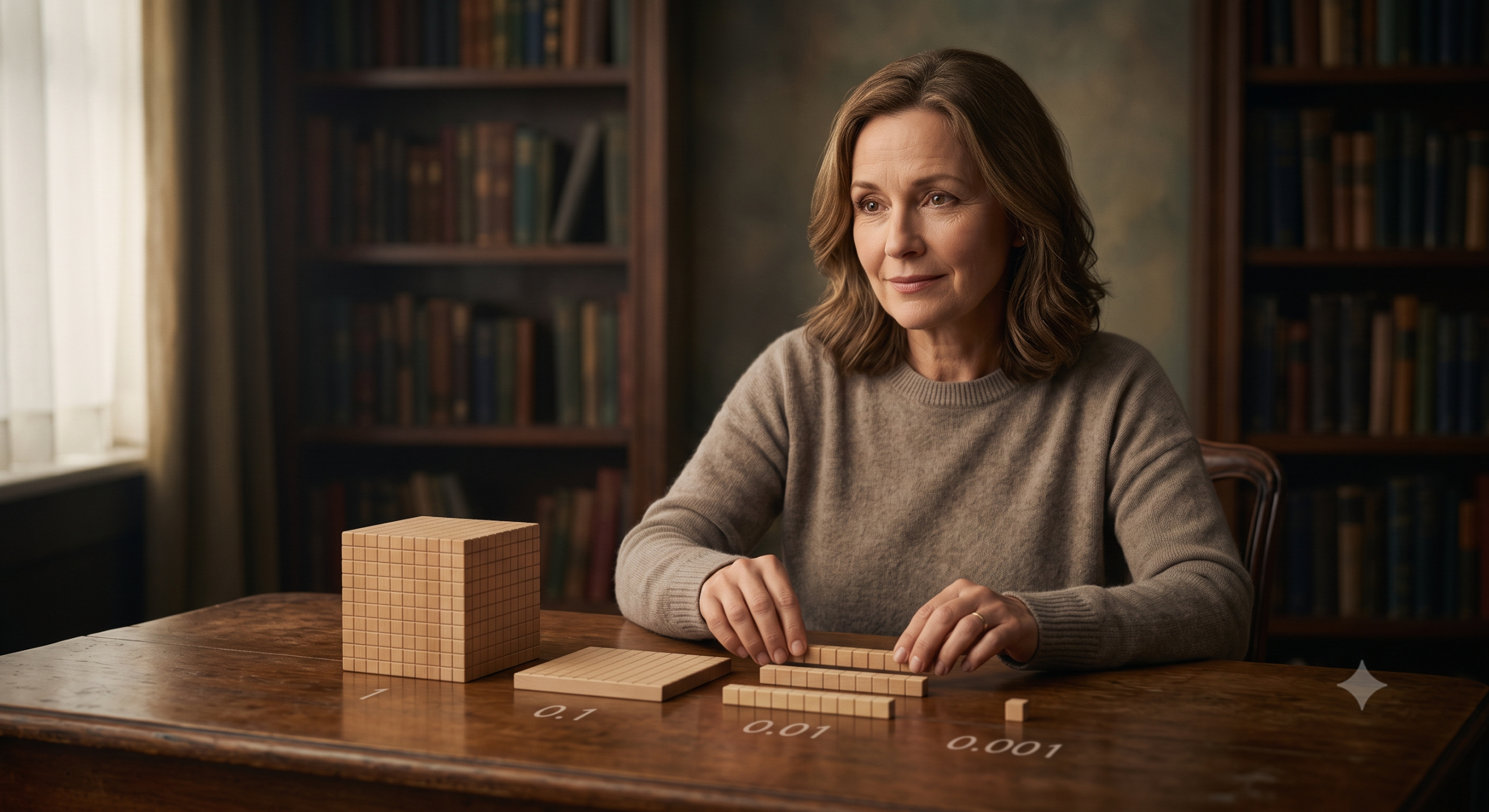
Let’s look at the butterfly’s wingspan: 0.375. The decimal point separates the whole numbers from the fractions.
| Ones | . | Tenths ((frac{1}{10})) |
Hundredths ((frac{1}{100})) |
Thousandths ((frac{1}{1000})) |
|---|---|---|---|---|
| 0 | . | 3 | 7 | 5 |
- The digit 3 is in the tenths place. Its value is 0.3
- The digit 7 is in the hundredths place. Its value is 0.07
- The digit 5 is in the thousandth place. Its value is 0.005
2. Composing and Decomposing
To decompose a number means to break it apart into its place value amounts.
To compose a number means to add the parts back together.
Sometimes we need to regroup. For example, 10 thousandths is equal to 1 hundredth (0.010 = 0.01).
3. Multiplying and Dividing by 10, 100, 1000
When we multiply or divide by powers of 10, the digits move positions relative to the decimal point!
Multiplying (Digits move LEFT)
- x 10: Digits move 1 place left.
e.g., 0.375 x 10 = 3.75 - x 100: Digits move 2 places left.
e.g., 0.375 x 100 = 37.5 - x 1000: Digits move 3 places left.
e.g., 0.375 x 1000 = 375
Dividing (Digits move RIGHT)
- ÷ 10: Digits move 1 place right.
e.g., 12.3 ÷ 10 = 1.23 - ÷ 100: Digits move 2 places right.
e.g., 12.3 ÷ 100 = 0.123 - ÷ 1000: Digits move 3 places right.
e.g., 1234 ÷ 1000 = 1.234
Game: The Decimal Digit Sorter
Tap a digit below to pick it up, then tap the correct place value box to drop it! Sort all digits for the number: 48.159
Digit Bank (Tap to select)
Activity 1: Place Value Identification
Identify the correct value of the underlined digits.
Activity 2: Compose the Number
Select the correct standard form for the decomposed values.
Activity 3: Moving Digits Challenge
Solve the multiplication and division problems by shifting the digits.
Lesson Summary
Decimals extend place value to the right of the decimal point: tenths, hundredths, and thousandths.
We can decompose numbers into parts (e.g., 0.125 = 0.1 + 0.02 + 0.005) and compose them back together.
Multiplying by 10, 100, 1000 moves digits to the left. Dividing moves digits to the right.
Final Assessment
Test your knowledge to complete the lesson.
Competency Checklist
Check off the skills you have mastered today!