
Maths: Year 6 17 Sections37 Lessons365 Days
8.2 Adding and subtracting fractions
Adding and Subtracting Fractions
Math Year 6
Lesson Competencies
At the end of the lesson you will be able to:
Identify the numerator and denominator in a fraction.
Find a common denominator for two fractions with different denominators.
Create equivalent fractions to make addition and subtraction possible.
Add and subtract two fractions with different denominators accurately.
Key Terms
Fraction
A number that represents a part of a whole. Written with a top and bottom number.
Numerator
The top number of a fraction. It shows how many parts we have.
Denominator
The bottom number of a fraction. It shows how many equal parts make up the whole.
Equivalent Fractions
Fractions that look different but have the exact same value (like ( frac{1}{2} ) and ( frac{2}{4} )).
Common Denominator
A shared multiple of the denominators of two or more fractions, required for adding or subtracting them.
Multiple
The result of multiplying a number by a whole number (e.g., multiples of 4 are 4, 8, 12, 16…).
Video Lesson
Watch this quick video to review finding a common denominator!
Core Lesson: The Pizza Puzzle
Introduction
Dear learners,
Imagine it is a Friday evening in Addis Ababa. Your family decides to order dinner! Two pizzas of equal size are delivered to your family.
The delicious cheese and tomato pizza is divided into 8 equal pieces. The spicy beef pizza from a famous international recipe is divided into 4 equal pieces.
Your brother, Dawit, is very hungry! He eats 3 pieces of the cheese and tomato pizza, and 1 piece of the beef pizza. How much of a whole pizza did he eat altogether? To find out, we need to add fractions with different denominators.
1. The Problem with Different Denominators
Dawit ate ( frac{3}{8} ) of the cheese pizza and ( frac{1}{4} ) of the beef pizza. We need to add them: ( frac{3}{8} + frac{1}{4} ).
Important Rule: You cannot add or subtract fractions unless their bottom numbers (the denominator) are exactly the same! It’s like trying to add apples and oranges.
2. Finding a Common Denominator
To make the denominators the same, we must find a common denominator. We do this by finding a common multiple of both numbers.
- Multiples of 4: 4, 8, 12, 16…
- Multiples of 8: 8, 16, 24…
The smallest number in both lists is 8. This is our common denominator!
3. Making Equivalent Fractions and Adding
Now, we change ( frac{1}{4} ) so it has an 8 at the bottom. We multiply both the numerator and the denominator by 2.
Now we can easily add! Just add the top numbers and keep the bottom number the same.
Dawit ate ( frac{5}{8} ) of a whole pizza!
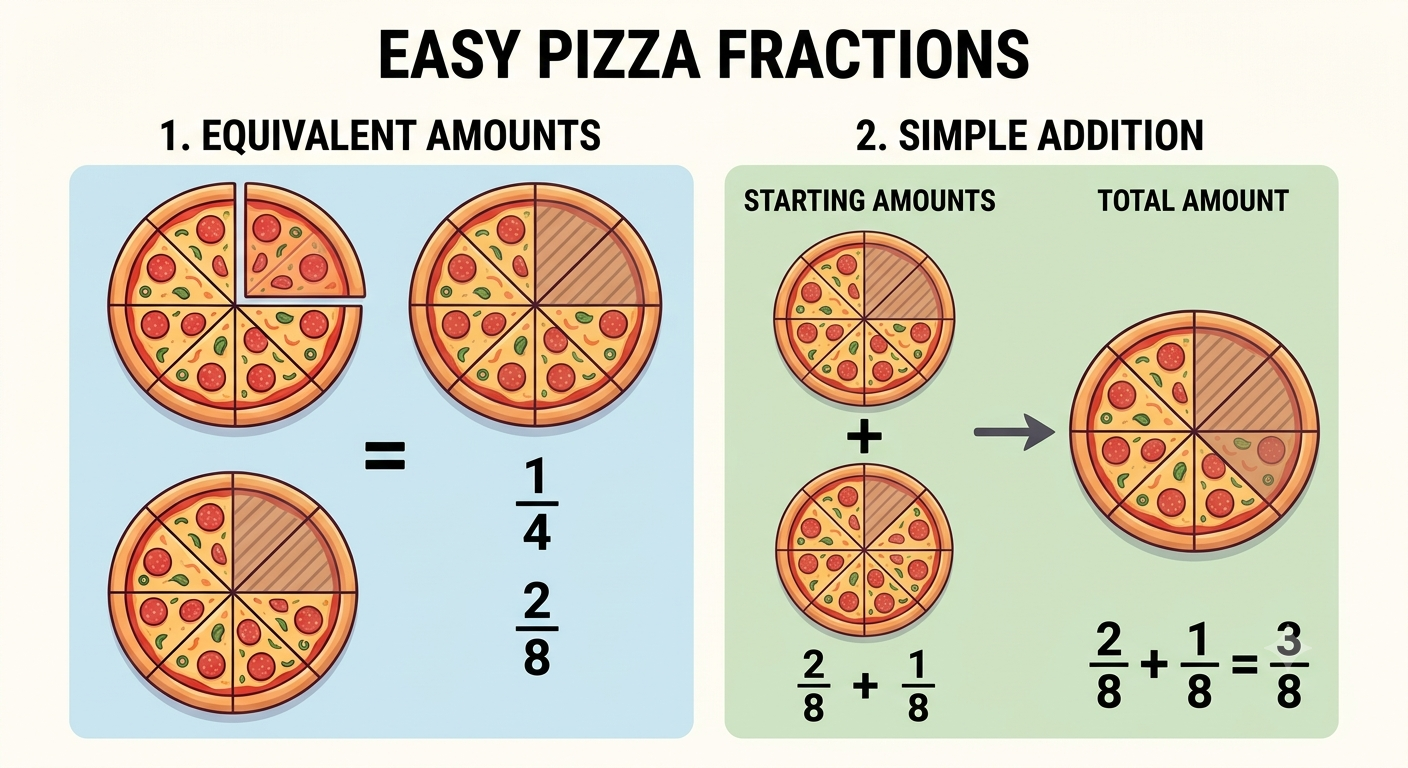
Activity: Equivalent Equation Matcher
How to Play: We need a common denominator before we can add! 1. Tap a blue fraction card below. 2. Tap the dashed box next to the starting equation to place the equivalent equation!
Equivalent Equations Bank
( frac{1}{2} + frac{1}{4} )
( frac{1}{3} + frac{1}{6} )
( frac{4}{5} – frac{3}{10} )
Activity 1: Knowledge Check
1 of 5Activity 2: Calculate & Fill
1 of 5Activity 3: Final Challenge
1 of 3Lesson Summary
Fantastic work! Let’s quickly review the golden rules of fractions you learned today:
The numerator (top) tells you how many parts you have, and the denominator (bottom) tells you how many parts make the whole.
You can never add or subtract fractions unless their denominators are exactly the same!
To make them the same, find a common denominator by looking for shared multiples.
Multiply both the top and bottom of a fraction by the same number to create an equivalent fraction before adding or subtracting.
Can you do it?
Check off the skills you feel confident about after completing this lesson.