
Maths: Year 6 17 Sections37 Lessons365 Days
8.1 Adding and subtracting decimal numbers
Adding and Subtracting Decimal Numbers
Math Year 6 (Cambridge Curriculum)
Lesson Competencies
At the end of the lesson you will be able to:
Compose, decompose and regroup decimals with up to 3 decimal places.
Estimate sums and differences of decimal numbers.
Add and subtract numbers with the same or different numbers of decimal places.
Use a trailing zero to align place values accurately.
Key Terms
Decimal Place
The position of a digit to the right of a decimal point (like tenths, hundredths, thousandths).
Trailing Zero
A zero added to the right of the last digit in a decimal. It does not change the value but helps align numbers.
Regroup
To rearrange groups in place value to carry out an operation, sometimes called carrying or borrowing.
Decompose
To break down a number into its separate place value parts (e.g., 2.3 = 2 ones + 3 tenths).
Compose
To put smaller units or place values together to make a larger complete number.
Estimate
To find a number close to an exact amount by rounding, useful for checking if an answer makes sense.
Video Lesson
Watch this quick video to review lining up decimals!
Core Lesson: Mastering Decimal Operations
Introduction
Dear learners,
Imagine you are shopping at the famous Mercato in Addis Ababa. You buy 1.5 kilograms of coffee and 0.75 kilograms of spices. The merchant needs to know the total weight. Or, consider Ethiopian athlete Kenenisa Bekele running a race where every thousandth of a second counts!
To solve real-world problems like these, we must know how to properly manipulate numbers with decimal points. Let’s break down the rules for adding and subtracting these numbers.
1. Composing and Decomposing
Before operating on decimals, it helps to understand what they are made of. To decompose a number means splitting it by place value.
= 1 ten + 4 ones + 3 tenths + 0 hundredths + 5 thousandths
= 10 + 4 + 0.3 + 0.005
To compose is the reverse: taking 2 ones, 4 tenths, and 8 thousandths gives us 2.408.
2. Estimating First
Always estimate before you calculate! Round the decimals to the nearest whole number to get a rough idea of the answer.
- Calculate: ( 12.8 + 4.15 )
- Estimate: ( 13 + 4 = 17 )
- If your final answer is nowhere near 17, you know you made a mistake!
3. Aligning and Trailing Zeros
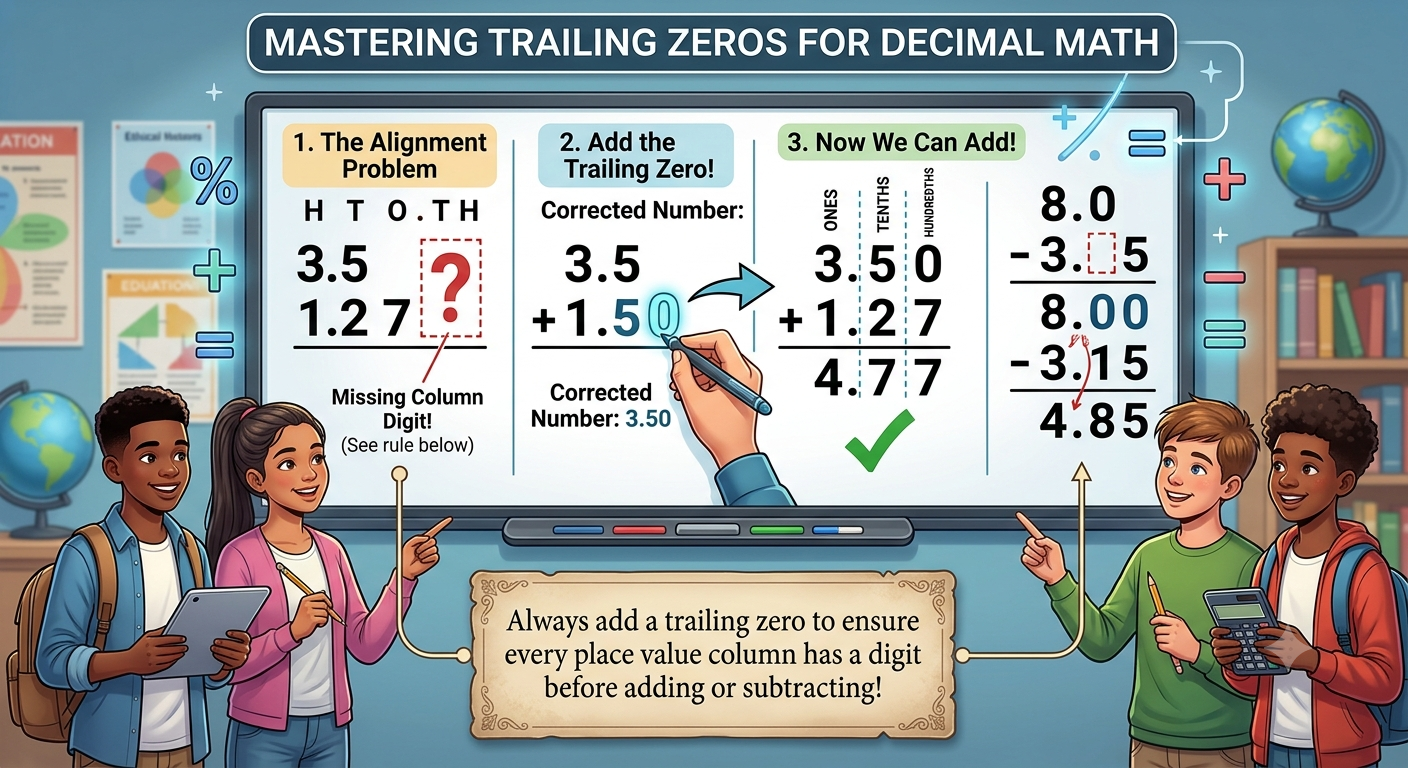
The most crucial rule: Line up the decimal points! If the numbers have different amounts of decimal places, add a trailing zero to fill the gaps.
Addition Example
Add: ( 4.5 + 2.13 )
+ 2.13
——
6.63
Subtraction Example
Subtract: ( 8 – 3.45 )
– 3.45
——
4.55 (Required regrouping)
Activity: Match the Equivalent Decimals
How to Play: 1. Tap a blue number card below. 2. Tap the dashed box next to the matching number (with trailing zeros added) to place it!
Numbers to Match
4.500
12.0
0.370
Activity 1: Multiple Choice
1 of 5Activity 2: Calculate & Fill
1 of 5Activity 3: True or False
1 of 5Summary
Compose and decompose decimals to understand their place values.
Always estimate before calculating to check if your final answer makes sense.
Line up the decimal points perfectly before you add or subtract.
Use trailing zeros to ensure numbers have the same number of decimal places.
Final Assessment
1 of 5Competency Checklist
Tap the boxes below to verify your mastery of this topic!