
Maths: Year 6 17 Sections37 Lessons365 Days
7.1 Rectangles and triangles
Rectangles and Triangles
Math Year 6
Lesson Competencies
At the end of the lesson you will be able to:
Estimate the area of a triangle.
Calculate the area of rectangles.
Understand how right-angled triangles relate to rectangles.
Work out the area of any triangle using a rectangle’s area.
Key Terms
Area
The amount of 2D space inside a flat shape, measured in square units (e.g., cm², m²).
Rectangle
A four-sided shape with four right angles. Opposite sides are equal in length.
Triangle
A three-sided polygon. The sum of its internal angles is always 180°.
Base & Height
The Base is the bottom line of a shape. The Height is the perpendicular line from the base to the highest point.
Video Lesson: Area of Triangles
Watch this short introduction on finding the area of triangles.
Core Lesson
Introduction
Dear learners,
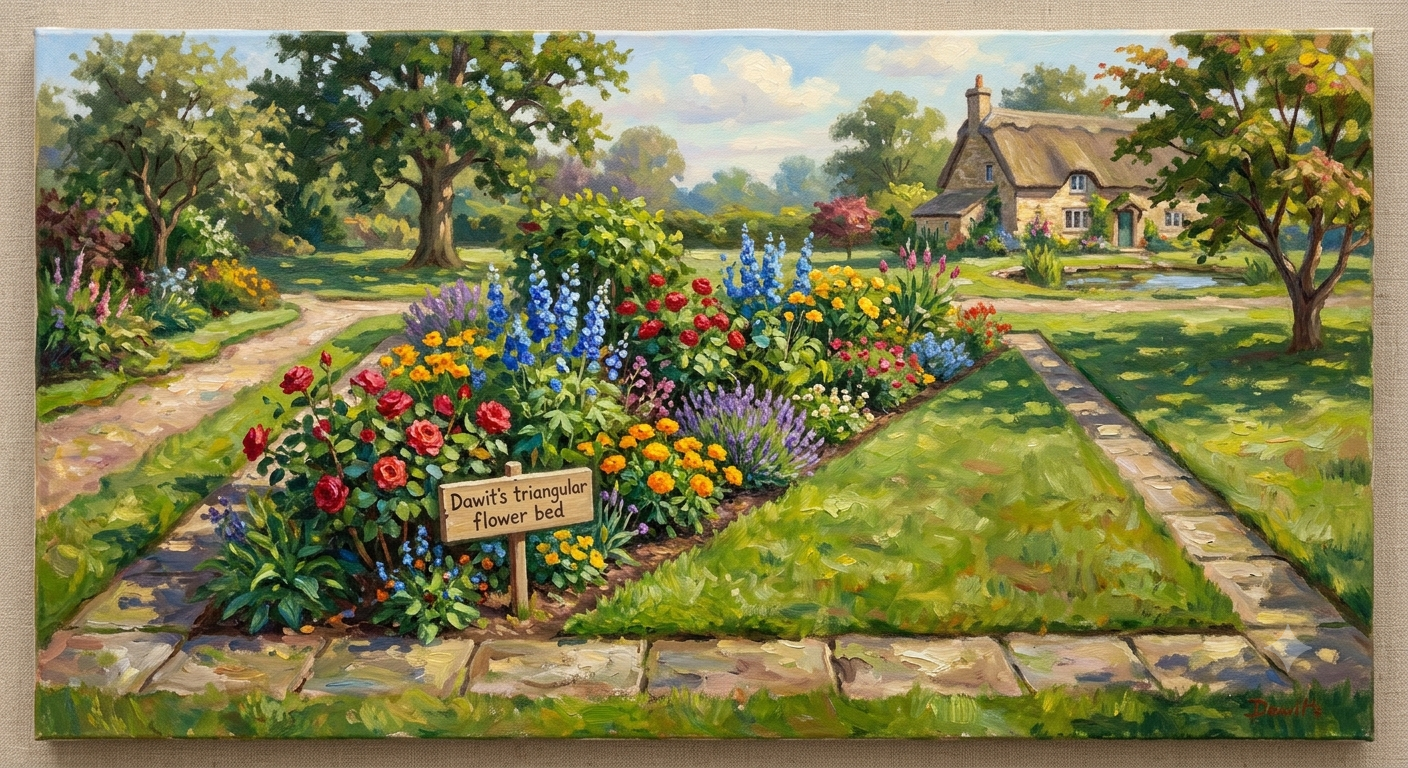
Imagine a farmer named Dawit in Ethiopia. He has a large, beautiful rectangular field where he grows Teff. Inside this field, he wants to mark out a triangular section specifically for planting bright yellow flowers.
To buy the right amount of seeds, Dawit needs to know the Area of that triangle. Let’s learn how to help him by understanding the secret relationship between rectangles and triangles!
1. The Area of a Rectangle
First, let’s remember how to find the area of a rectangle. You simply multiply the length of the base by the height.
Area of Rectangle = Base × Height
( A = b times h )
If Dawit’s rectangular field has a base of 10 meters and a height of 6 meters, the area is ( 10 times 6 = 60 ) square meters ((m^2)).
2. Cutting the Rectangle in Half
What happens if you draw a diagonal line straight across a rectangle from one corner to the opposite corner? You split the rectangle into exactly two identical right-angled triangles!
Because the rectangle is cut exactly in half, the area of one of those triangles is exactly half the area of the rectangle.
Area of a Triangle = Half of (Base × Height)
( A = frac{1}{2} times b times h )
3. What About Other Triangles?
This amazing rule works for ANY triangle! You can imagine drawing a rectangle snugly around any triangle. As long as the triangle shares the same base and reaches the same height as the rectangle, the triangle will take up exactly half the space.
Let’s play with this idea in the interactive lab below. Drag the top point of the triangle left and right. Notice how the shape changes, but its area stays exactly the same as long as the base and height don’t change!
Interactive Geometry Lab
Drag the glowing red dot horizontally.
Let’s look at an Example
Problem:
A triangle in London has a base of 8 meters and a height of 5 meters. What is its area?
Step 1: Write the formula.
Area = 1/2 × base × height
Step 2: Put in the numbers.
Area = 1/2 × 8 × 5
Step 3: Multiply.
First, 8 × 5 = 40. Then find half of 40.
Area = 20 square meters (m²)
Game: Area Builder Sorter
How to play (Mobile Friendly): 1. Tap a triangle card below to select it. 2. Tap the correct Area Box to drop it in.
Triangles (Select One)
Area = 12 cm²
Area = 20 cm²
Area = 30 cm²
Activity 1: Estimating & Calculating
Activity 2: Find the Missing Value
Activity 3: Geometry Logic
Lesson Summary
1. The area of a rectangle is found by multiplying its Base by its Height ((A = b times h)).
2. A triangle takes up exactly half the space of a rectangle with the same base and height.
3. The formula for the area of a triangle is: (A = frac{1}{2} times b times h).
4. Always remember to write your answer in square units (like cm², m²).
Final Assessment
Competency Checklist
Self-assess your learning. Click the boxes if you feel confident.